
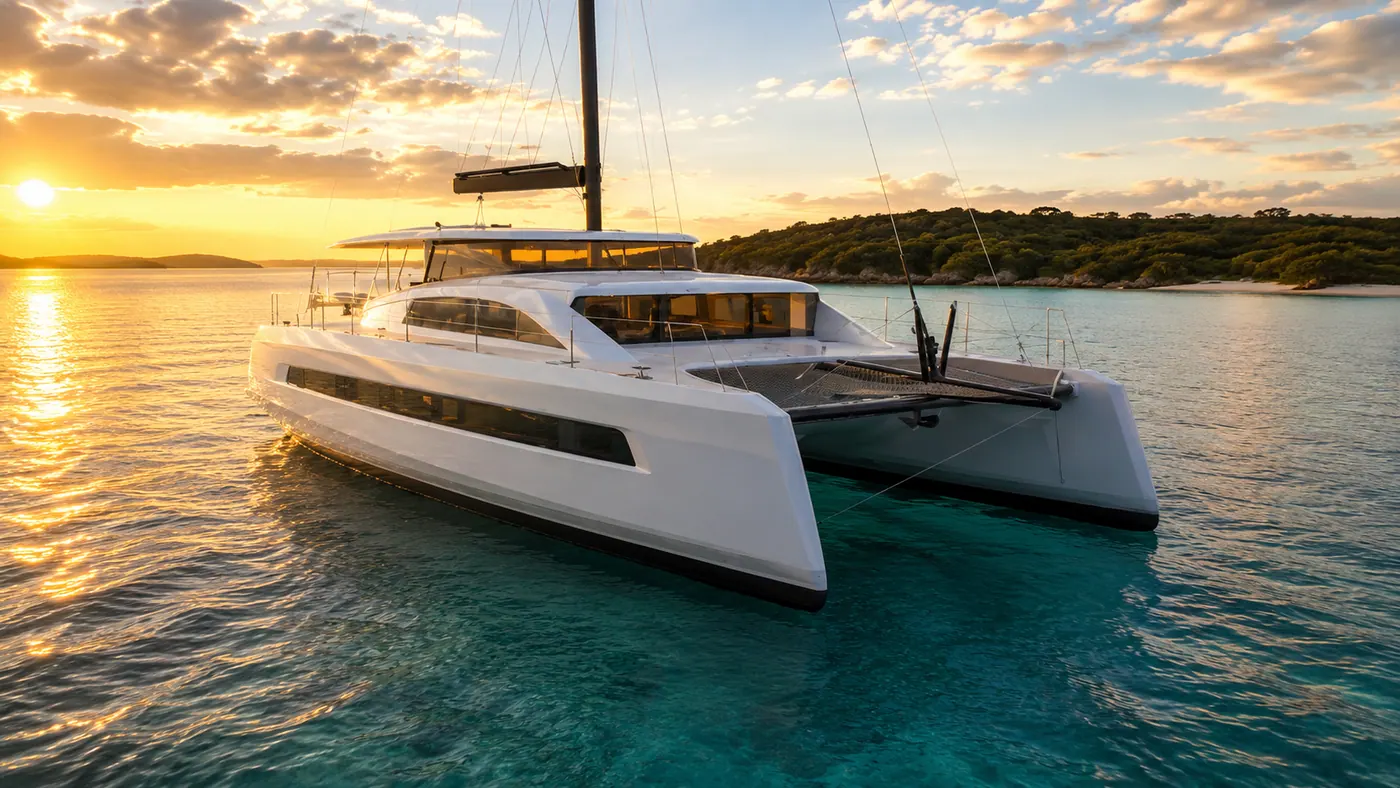
Captain's Summary
The useful part of the curve is where the route takes you.
- The Antares 46 was designed for world cruising, with useful speed across a broad range of sailing angles.
- Reaching and broad-reaching matter most because passagemakers spend long stretches of a route at those angles.
- At 12 knots true wind, the designer VPP predicts 9.50 knots at 90° and 8.84 knots at 120°.
- At 20 knots true wind, it predicts 15.71 knots at 100° and 14.38 knots at 120°.
- Each comparison line includes its source and configuration so buyers can see where the numbers came from.
- A polar is a target. Sea state, loading, sail choices and crew rhythm decide the speed used offshore.
Design begins with the route
A world-cruising boat should be judged where its owners spend their miles.
Ocean passagemakers work with seasons and prevailing wind. That puts long stretches of a circumnavigation on a reach, a broad reach or deeper downwind. The boat settles into a rhythm. The crew stands watches, cooks, sleeps, makes water and keeps moving.
That is the sailing life the Antares 46 was designed around. Upwind ability remains part of the envelope, but the boat puts useful speed at the angles that carry owners across oceans and between cruising grounds.
The best number is not the boat's speed at its most flattering angle. It is the speed a crew can use hour after hour, with the boat loaded and the next watch coming up.
An intentional curve
The polar shape matters more for passage making.
Look across the Antares curve from 70° through 135°. At 12 knots true wind, the curve stays near nine knots from 70° through 120°. At 20 knots, predicted speed remains above 12 knots from 80° through 135°.
Those are design predictions, not passage promises. They show useful speed across the angles a cruising route is likely to use, rather than one flattering test point.
Why show the competition
Buyers should be able to compare.
Turn on Balance 464, HH44, Seawind 1370 and Vision 444-11 below. Then move the wind angle into the part of the route you care about.
The lines are not a universal race result. One comes from a numeric VPP, another from a manufacturer graphic, and each uses different loading, sails and appendages. Check those details before comparing speeds.