Published light displacement
The starting point before cruising stores, fluids, equipment, dinghy, and personal gear are aboard.
Antares performance is measured the way owners actually sail: loaded for passages, balanced across wind angles, and supported by published data, owner reports, and passage results.
Evaluate the Antares 44 in cruising trim, not as an empty boat. The useful benchmark is a 23,700 lb cruising-displacement assumption that reflects passage preparation.
From there, performance is best read through a few connected references: sail area, reported owner speeds, World ARC results, sail crossover guidance, and planning polars.
Used carefully, ratios help buyers compare sail plan, displacement, and likely cruising behavior with more context.
The starting point before cruising stores, fluids, equipment, dinghy, and personal gear are aboard.
A more useful comparison assumption for owners planning passages and extended time aboard.
The ratio cited for the Antares 44 using mainsail plus genoa against cruising displacement. 24 applies to the Tall Rig configuration.
Sail area to displacement helps compare available drive against cruising weight. It is most useful when based on cruising displacement rather than light-ship figures.
The ratio still needs context: sea state, sail condition, trim, reefing choice, bottom condition, crew, and loading all influence the day’s result. The strongest performance story combines ratios with owner-reported speeds and actual passages.
The Antares 44 sail inventory gives owners practical choices without adding unnecessary complexity. Main, genoa, jib, and optional screecher support different angles, wind strengths, and passage plans.
The Tall Rig option can suit lighter-air cruising grounds, preferred handling styles, and owners who want more sail-driven performance before turning to engines.
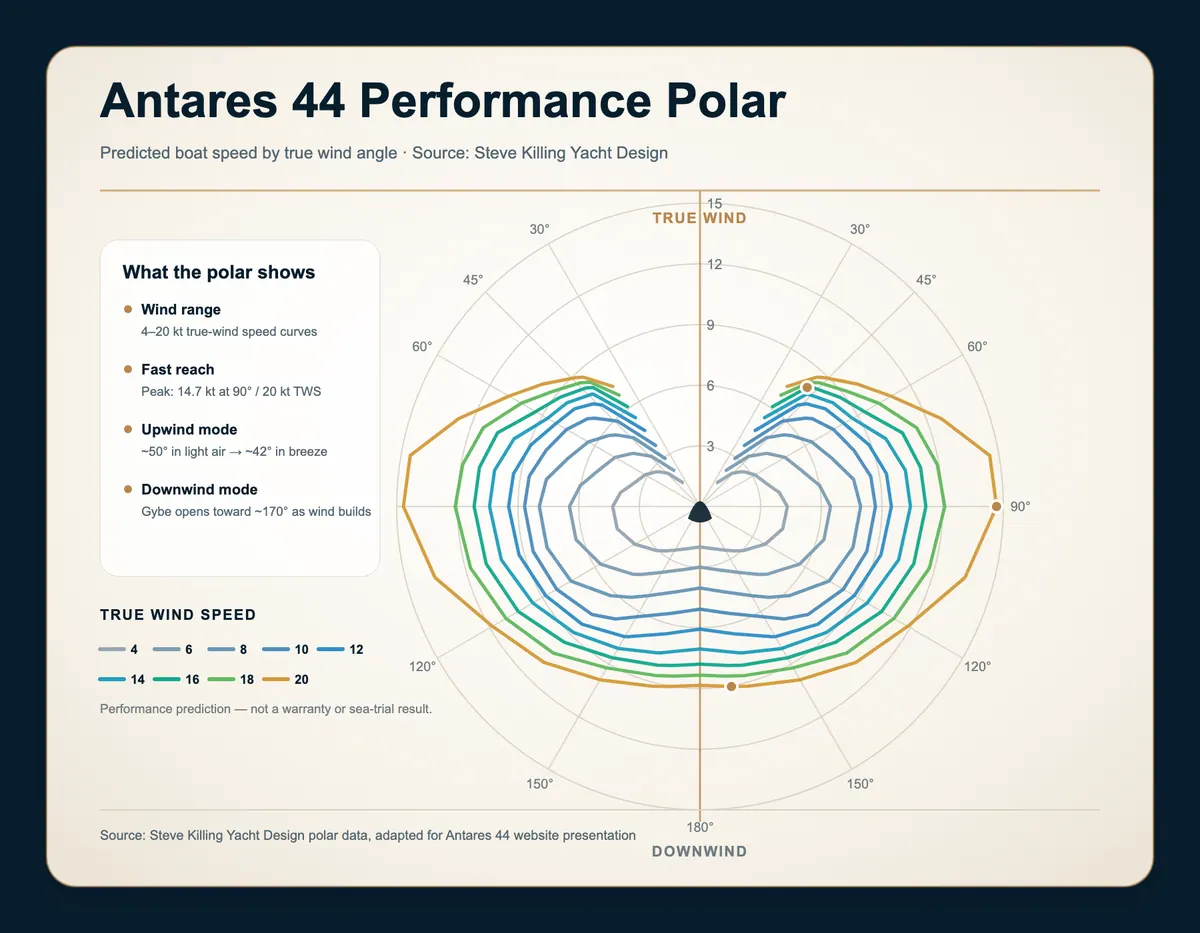
The Antares 44 performance polar developed from Steve Killing's design work helps set practical routing expectations before a passage begins. Use it alongside sail crossover guidance, owner reports, and actual conditions underway.
“We are in front of all the catamarans…”
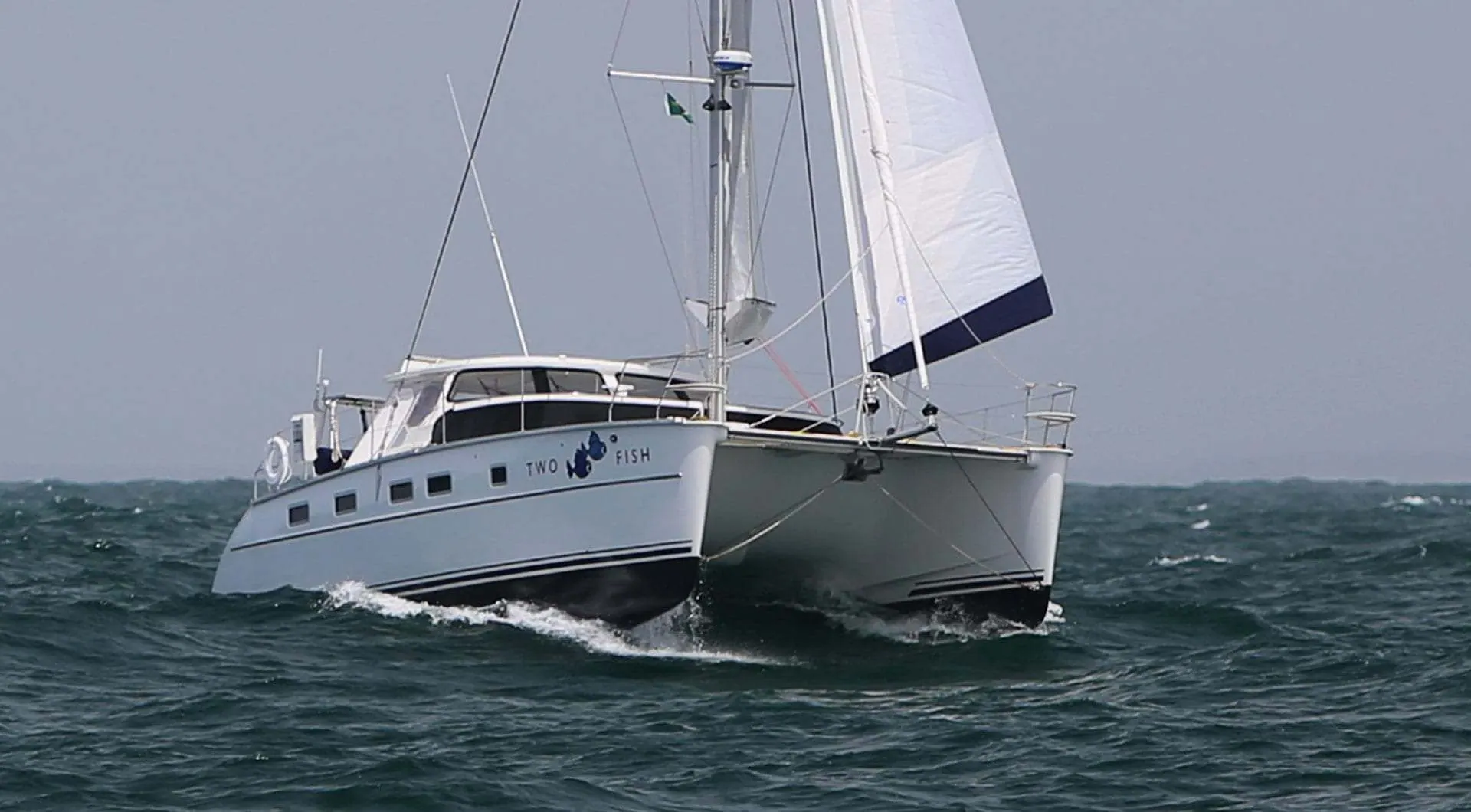
Jason S., aboard Antares s/v Two Fish, Galapagos to Marquesas leg
Antares s/v Two Fish placed first among 9 catamarans in the multihull division on the first leg to the Galapagos Islands.
Blue Dawn, an Antares 44i, sailed from the US Virgin Islands to Cadiz, Spain in a little over three weeks, averaging about 7 knots.
These Antares data points are presented with owner context and owner sailing conditions. They are intended as practical reference ranges, with actual speeds varying by sea state, trim, load, and sail condition.
A few practical questions help connect the numbers to cruising decisions.
Cruising displacement starts with published light displacement and adds anchor, chain, 75% liquid capacity, dinghy, outboard, and personal gear/provisions. Antares uses a 23,700 lb cruising-displacement assumption for this Antares 44 performance reference.
It gives a useful comparison point for how much sail plan is available relative to loaded displacement. It is not a full performance prediction by itself, because sea state, trim, sail choice, crew, and loading still matter.
Reported loaded-cruising speeds, wind angle, sail combination, and passage results give buyers a more useful reference than light-ship numbers alone.
Tall Rig belongs in the sail-plan conversation for buyers who expect lighter-air cruising grounds or want more drive before starting engines. It should be matched to crew, cruising area, loading, and reefing habits.
Yes. Antares performance polars are available as planning references for routing conversations. They are based on Antares 44 performance work and should be used as guidance, not guaranteed performance promises.