
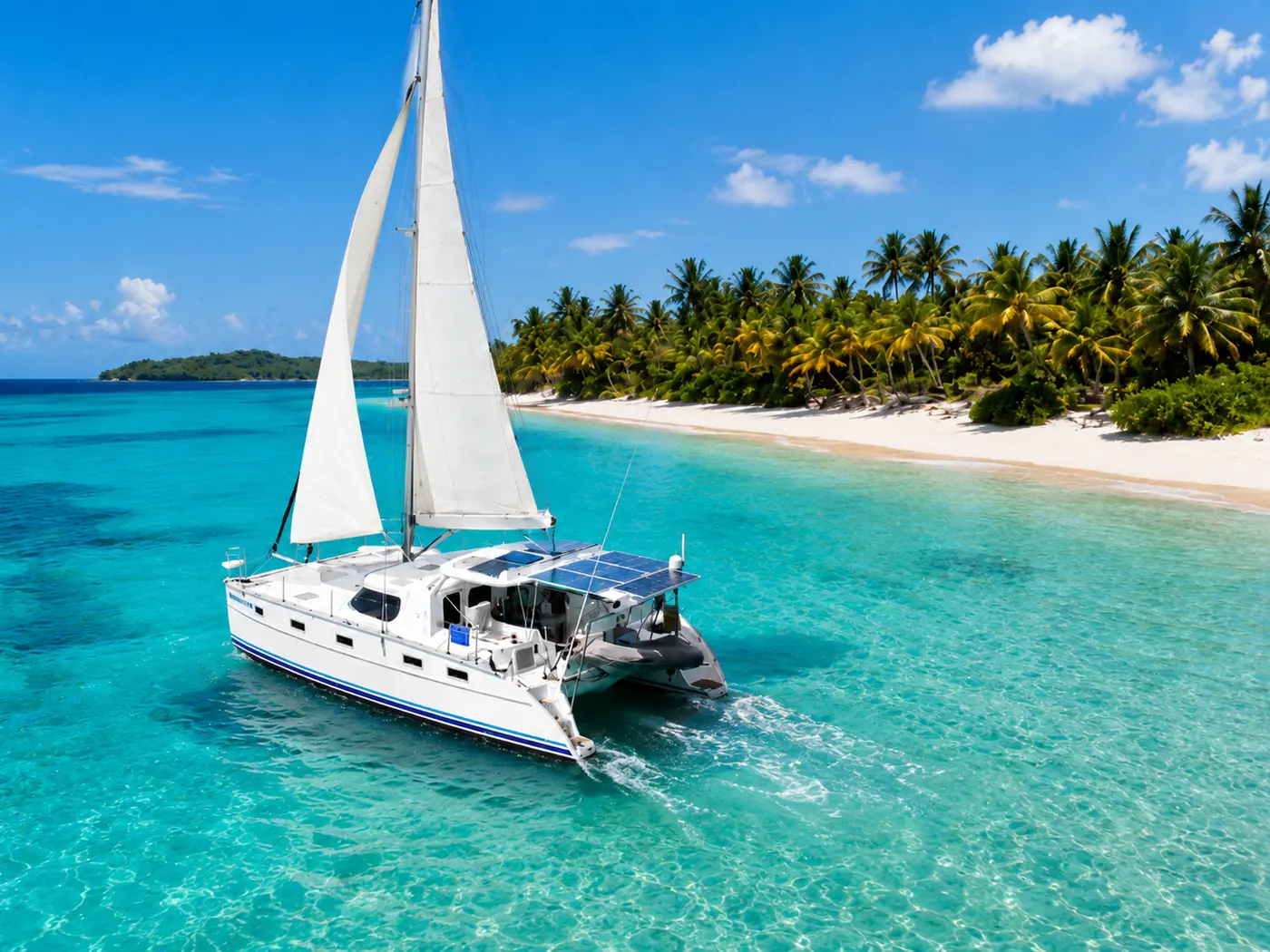
Sail choices should match crew workload, passage plans, handling systems, and long-term maintenance.
- The original sail-selection guide is preserved below with its handling, longevity, and performance structure.
- The buyer question is not the biggest inventory of sails. It is which sail plan fits the crew and the passages they expect to make.
- Use the guide to discuss downwind sailing, reefing habits, sail care, replacement timing, and how the boat is equipped for practical handling.
The Captain’s Summary: Choosing the right sail inventory is the most critical decision a luxury cruiser makes to balance blue-water performance with ease of handling. This guide breaks down the “Antares Advantage” regarding sail materials, cuts, and configurations to ensure your catamaran remains both fast and manageable in all sea states.
Key Takeaways:
- Durability vs. Performance: High-tech laminates like Palma Tec offer the best balance of UV resistance and shape retention for long-term cruising.
- The Handling Debate: While In-Mast Furling offers unparalleled convenience for shorthanded crews, the Slab Reefing system remains the gold standard for performance-oriented sailors.
- Specialty Sails: Understanding the nuance between a Code Zero and a Screecher is vital for optimizing your light-wind reaching capabilities.
The Science of Sail Cloth: Why Material Matters
When outfitting a world-class catamaran like an Antares, the choice of sail cloth is about more than just speed; it is about longevity and UV resistance. In tropical environments, the sun is your greatest enemy. While standard Dacron is a traditional choice, it is prone to “creeping” or stretching over time, which ruins the sail’s aerodynamic profile.
The Antares Advantage often lies in Palma Tec or X-Drive laminates. Unlike generic cruise-laminates, Palma Tec utilizes Dyneema threads throughout the matrix. This ensures the sail maintains its designed shape for years, not just months. For those seeking the ultimate in durability, high-quality stitching using Ultra-P fiber provides superior UV resistance compared to standard threads, preventing the seams from failing long before the cloth does.
Defining the “Life” of a Sail
- Titanium/Racing Laminates: Optimized for weight but have a shorter lifespan, often only 2-3 years of peak performance.
- X-Drive/Endurance Sails: Robust construction with a 7-year lifespan and excellent shape retention.
- Radial Cruising Laminates: The “Captain’s Logic” choice for liveaboards, often lasting 10+ years with proper care.
Sail Cuts: Radial vs. Cross-Cut
The efficiency of your sail is determined by the direction of the fibers relative to the load. In a Radial Cut, the panels are oriented to align the strongest fibers with the primary stress points of the sail (the head, tack, and clew). This allows us to use variable weights—heavier cloth where the load is high and lighter cloth elsewhere—to reduce overall weight without sacrificing strength.
Conversely, Cross-Cut sails feature panels running parallel to the foot. While simpler, they often rely on the inherent strength of the cloth rather than the orientation of the panels. In high-performance applications like the X-Drive system, carbon or aramid fibers are laid across a cross-cut body to bridge the loads, providing a hybrid solution that offers both strength and ease of repair.
The Great Debate: In-Mast Furling vs. Slab Reefing
There is no single “right” answer, only the right answer for your crew. At Antares, we provide the flexibility to choose based on your sailing style. In-Mast Furling is the ultimate tool for the shorthanded luxury buyer. It allows for infinite reefing points and can be operated entirely from the safety of the cockpit. To compensate for the reduced sail area inherent in furling mains (due to the lack of a large roach), Antares utilizes a longer boom to maintain the necessary power.
Slab Reefing (or “Classic” main) remains the preference for those who prioritize “Captain’s Logic” performance. By utilizing full horizontal battens and a Square Top or Large Roach design, you gain approximately 5-6% more sail area. This translates directly to better light-wind performance and a higher pointing angle.
Configuration Comparison
| Feature | In-Mast Furling | Slab Reefing (Classic) |
|---|---|---|
| Ease of Use | High (Cockpit controlled) | Moderate (Requires line management) |
| Sail Shape | Flattened (Vertical battens) | Optimized (Horizontal battens) |
| Performance | Standard | High (Increased Roach/Square Top) |
| Safety | Mechanical dependency | Manual reliability |
Light Wind Weaponry: Code Zero vs. Screecher
Confusion often surrounds these two sails, but the distinction is simple: The Angle. A Screecher is essentially a massive, lightweight Genoa designed for very tight reaching angles. It features a straight luff and a hollow leech, making it a “drifter” for the modern age.
A Code Zero features a more “positive roach” (a curved outer edge) and falls between a Genoa and an Asymmetrical Spinnaker. For the Antares owner, we recommend a heavy-duty Code Zero. This allows you to keep the sail flying in 15-18 knot gusts without fear of tearing the material, providing a significant boost to your average cruising speeds during ocean passages.
The Downwind Strategy: Asymmetricals and Parasailors
For true downwind sailing (150° to 180°), the Asymmetrical Spinnaker is a versatile tool. By adjusting the tack line, you can rotate the sail to windward, allowing the catamaran to sail deeper angles than a monohull. However, for long-range trade-wind cruising, many owners opt for the Parasailor. Its unique “wing” design acts as a stabilizer, reducing the hobby-horsing motion of the hulls and providing a self-trimming quality that is perfect for overnight passages.
Technical Specifications Table
| Sail Type | Standard Material | Weight (Typical) | Best Wind Angle |
|---|---|---|---|
| Main Sail | Palma 139 / 18 | 9.0 oz – 9.5 oz | All Points |
| Genoa | Palma 139 | 8.0 oz | 45° – 110° |
| Code Zero | 155P Polyester | 3.1 oz | 60° – 130° |
| Storm Jib | Heavy Dacron | 9.5 oz | Extreme Weather |
Conclusion: Setting the Standard
Your sails are the engine of your Antares. You can choose the easy push-button control of an in-mast furling system. Or, you might prefer the strong power of a square-top slab reefing main. Knowing the materials and design helps keep you safe and happy at sea. Remember, a well-maintained sail is not just a performance tool—it is your primary safety feature when crossing oceans.