
Bluewater comparison should start with the use case, not a generic ranking.
- The original buyer guide is preserved below with its structure, criteria, links, and comparison logic.
- A bluewater catamaran decision should be tied to offshore use, owner skill, support, systems access, and long-term living needs.
- Use the article as a screening tool, then confirm model-specific details with Antares.
When did the industry consensus decide that a cockpit designed to seat eight for dockside entertaining was suitable for an ocean voyaging vessel? And what is wrong with having the entire aft bulkhead pierced with sliding patio doors, as if the boat were a beachfront condominium rather than a vehicle for crossing oceans? (A question Ted’s asked before, without receiving a satisfactory answer.)
Apparently, the traditional insistence on defending against a breaking following sea — potentially much higher than the vessel itself — is no longer necessary. Perhaps modern catamarans have simply become too clever for the ocean to bother with.
The trouble, of course, is that the heaviest advertisers control editorial policy, and the charter market (where boats are used for a week at a time in protected waters) drives volume production. The result is an abundance of vessels marketed as “bluewater capable” that would give any experienced circumnavigator pause.
So suppose we approached the question differently. Suppose we asked not which catamaran has the most impressive brochure, but which design features actually matter when you’re three weeks from the nearest haulout facility and the weather has turned disagreeable. What would we look for?
The 30-Inch Question: Bridge Deck Clearance
I often see 30 inches (76cm) cited as the minimum required bridge deck clearance for offshore work. One wonders where this figure originated — perhaps it was adequate for a particular vessel of a particular dimension at a particular moment in time, and somehow became gospel. A more detailed treatment of the geometry involved exists for those inclined to pursue the matter further.
The trouble is that wave geometry doesn’t scale linearly with the boat, though the marketing brochures tend to treat all numbers as interchangeable. A 44-foot catamaran with moderate hull spacing has rather different requirements than a 50-foot vessel of considerable beam.
Maybe any boarding wave crest will simply spill back out over the stern as the boat is tipped up on the wave back? The stern will certainly not rise very quickly. As you know, these waves travel in sets. What if it does, though, and throws tons of water through the cockpit…
The practical test is simple enough. Take a sea trial in choppy conditions — Force 4 or 5 will do, you needn’t wait for a gale. Lie on the trampoline with your head over the crossbeam and observe what happens aft under the bridge deck. It’s an instructive experience, though you may not wish to repeat it if the motion disagrees with you. If you observe solid water slamming against the structure with sufficient force to make the vessel shudder — well, you’ve probably exceeded that design’s comfortable wave tolerance. The noise is merely an accompaniment; it’s the structural insult that matters over thousands of miles.
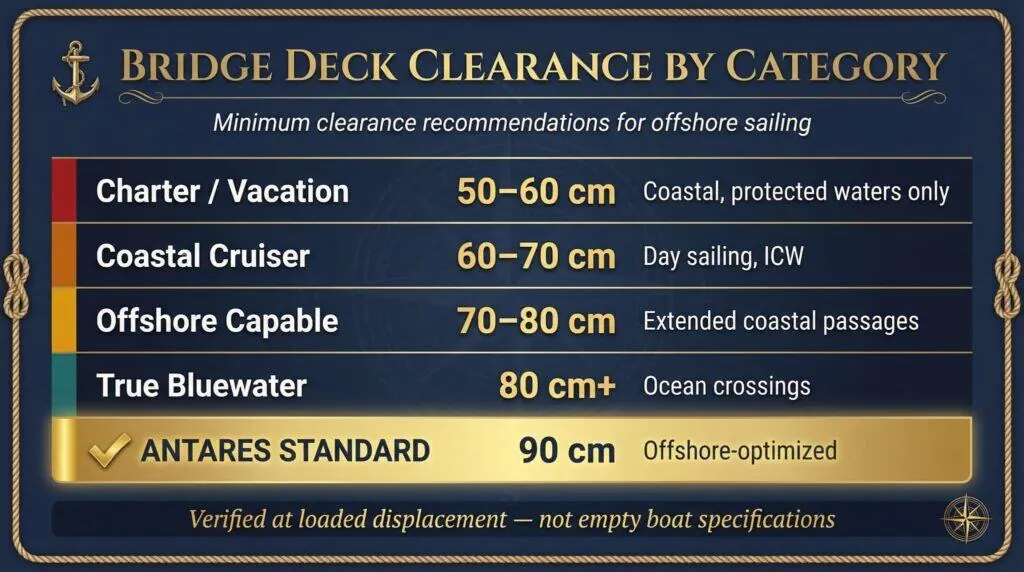
I can’t advise you on your particular cruising plans, but I would observe that the sailors I respect most tend to err on the side of clearance. They’ve already made the mistakes that inform their preferences.
CE Category A: The Non-Negotiable Starting Point
CE Category A certification is the only rating that matters for ocean crossings. The European Union’s Recreational Craft Directive requires documented engineering analysis for this classification — it’s not a marketing label you obtain by ticking boxes on a form.
What Category A requires:
- Stability analysis including capsize screening formula under 2.0 (lower is better)
- Structural engineering validation for hull strength, bridge deck loads, and mast compression
- Stability and buoyancy assessment — for habitable multihulls, ISO 12217 assesses susceptibility to inversion, inverted flotation, and viable means of escape rather than monohull-style self-righting
- Safety equipment integration: liferaft storage accessible from both hulls, fire suppression systems, and escape hatches
- Testing for winds over Beaufort Force 8 (40+ knot sustained) and waves exceeding 4 meters
The red flag, of course, is any boat marketed as “CE Category B” or “coastal/offshore capable.” Category B is designed for winds to Force 8 and waves to 4 meters — fine for Caribbean island-hopping, insufficient for Pacific crossings where conditions routinely exceed these thresholds. I can’t readily explain why a builder would suggest such a vessel for circumnavigation, but the brochures often do.
How to verify: Ask the builder or dealer for the CE Declaration of Conformity. Legitimate manufacturers have this documentation and will provide it. If they can’t or won’t — well, that rather tells you something, doesn’t it?
The Antares catamaran was designed by Ted Clements, with every design decision reflecting offshore-first engineering rather than marina-first aesthetics. The original company, PDQ, was founded by Dr. Harvey Griggs — an MIT graduate in structural engineering who commissioned the first yacht — and Alan Slater, chief engineer and long-time advocate for catamarans. The heritage of engineering rigor continues in every hull built today, as visible in the construction process. Antares has built exclusively CE Category A certified catamarans since 2007.
Construction Quality: What You Can’t See at a Boat Show
Shiny gelcoat and teak interiors are visible. The construction details that determine whether your hull survives a grounding in the Tuamotus are not.
Hull construction methods matter:
- Resin type: Vinylester resin resists osmosis and delamination better than polyester. Vinylester costs 30-40% more — many production builders skip it.
- Lamination method: Vacuum infusion creates consistent resin-to-fiber ratios and eliminates voids. Hand layup is cheaper but introduces variability that weakens critical load areas.
- Core materials: High-density foam cores provide insulation and stiffness. Low-density cores save weight and cost but compress under sustained load.
Here’s a point worth considering: catamarans don’t heel to bleed off wind pressure, so the rig and the structure that carries it into the hulls must handle loads a monohull sheds through heel. That is why spar makers size multihull rigs from the boat’s calculated righting moment rather than monohull rules of thumb — Ted Clements’ mast-load discussion walks through the engineering basis. The implication is straightforward: structural engineering rigor matters more on catamarans. A rigging failure at sea is not an inconvenience; it can be a trip-ender, or worse.
Critical structural details:
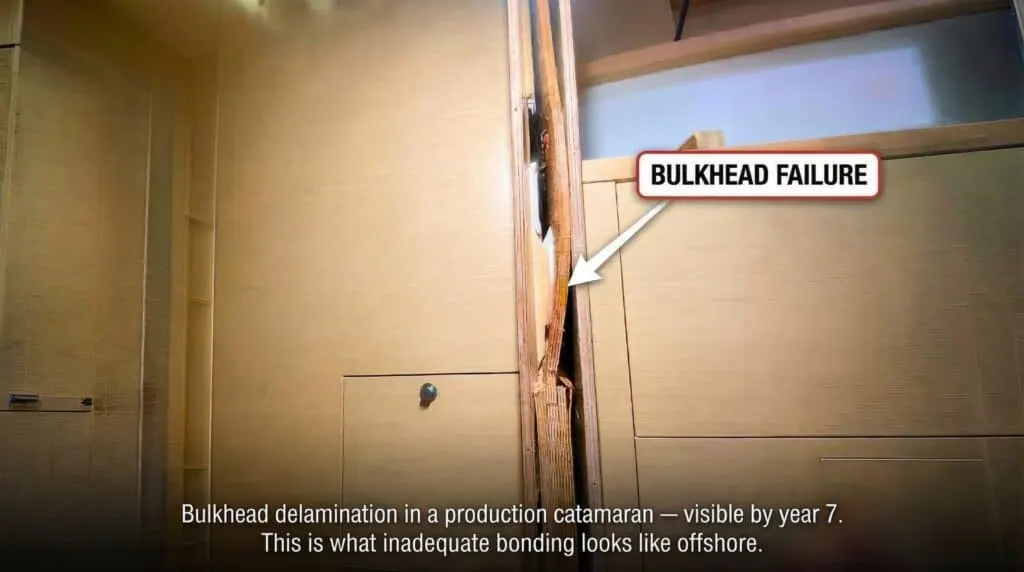
- Bulkhead bonding: Should be bonded 360° to hull and deck, not just tabbed at corners. 360° bonding distributes impact loads across the entire hull structure.
- Stringer integration: Stringers and frames must be fully integrated into the hull laminate, not just glued in place. This determines how the hull handles twisting forces in heavy seas.
- Deck-to-hull joint: Should be through-bolted on close centers (typically 150-200mm) AND chemically bonded. One without the other is insufficient.
The 10-year test is instructive: ask to see 10-year-old examples of any catamaran you’re considering. Production boats often show structural issues by year 5-7 — stress cracks at bulkheads, deck flex, osmotic blistering. Quality construction reveals itself in how boats age, not how they look on delivery day.
Antares hulls have logged hundreds of thousands of offshore miles. Pre-owned Antares and PDQ boats from 2004-2005 continue circumnavigating with original hull integrity — the construction quality is visible in their longevity, if not their showroom gloss.
Design Differentiators: Skegged Rudders and Steering Survivability
Most modern catamarans use spade rudders — blades mounted on a stock that extends down from the hull bottom with no additional support. Spade rudders offer low drag and responsive handling, which is why racing boats and coastal cruisers favor them. The tradeoff is vulnerability: hit something with a spade rudder, and the full impact loads the rudder stock, bearings, and steering gear.
The Antares uses a skegged rudder. A skeg is a fixed, vertical fin mounted forward of and partially supporting the rudder blade. The rudder pivots within a cutout in this protective structure. In practical terms, the skeg acts as a buffer — it takes the hit from floating debris, submerged logs, or coral heads before the rudder does.
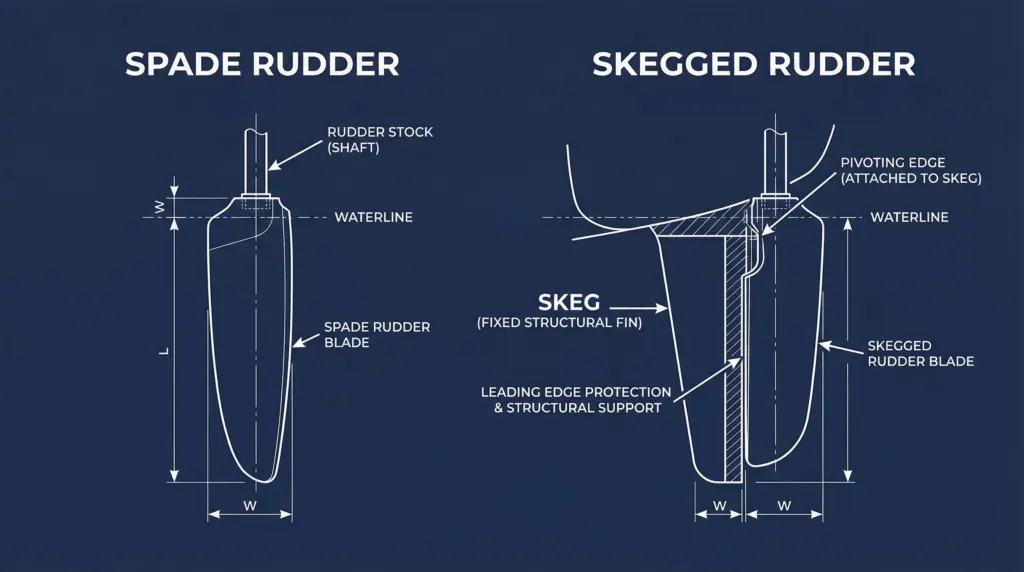
Now consider the ARC rally and circumnavigator data on offshore failures. Rigging failure and steering/autopilot failure consistently rank as the top failure points. When your autopilot fails (and at some point, it will), you need a rudder that remains functional and steerable. A skeg protects that rudder. It’s a simple mechanical advantage: lose steering three weeks from land, and you’ll appreciate the difference between a damaged skeg and a destroyed rudder stock.
Grounding survivability follows from this design. Touch bottom with a skegged rudder and the skeg absorbs the impact, often leaving the steering system intact. Even a hard grounding may damage only the replaceable skeg rather than the rudder stock and internal steering gear. Tracking ability in following seas is a subtler benefit — the skeg provides directional stability when waves are pushing from behind, reducing the exhausting “sailing sideways” sensation that can make downwind passages wearing.
The tradeoff is slightly more drag and a bit less instant response than a spade rudder. But for a boat designed to cross oceans, not win round-the-buoys races, that’s an acceptable exchange. Offshore boats prioritize damage tolerance over theoretical performance.
Shaft Drives: Serviceability as Safety
Saildrives have become the default for production catamarans. They package the engine, transmission, and propeller into a compact unit mounted through the hull bottom — clean, efficient, and simple to install during production. The propeller sits on a leg that extends below the hull, and a large rubber boot seals the drive unit to the hull interior.
Shaft drives take a different approach: the engine sits entirely inside the hull, and a straight shaft extends through a stern tube to an external propeller. The seal is a conventional stuffing box or modern dripless seal — much smaller than a saildrive boot, and accessible from inside the boat.
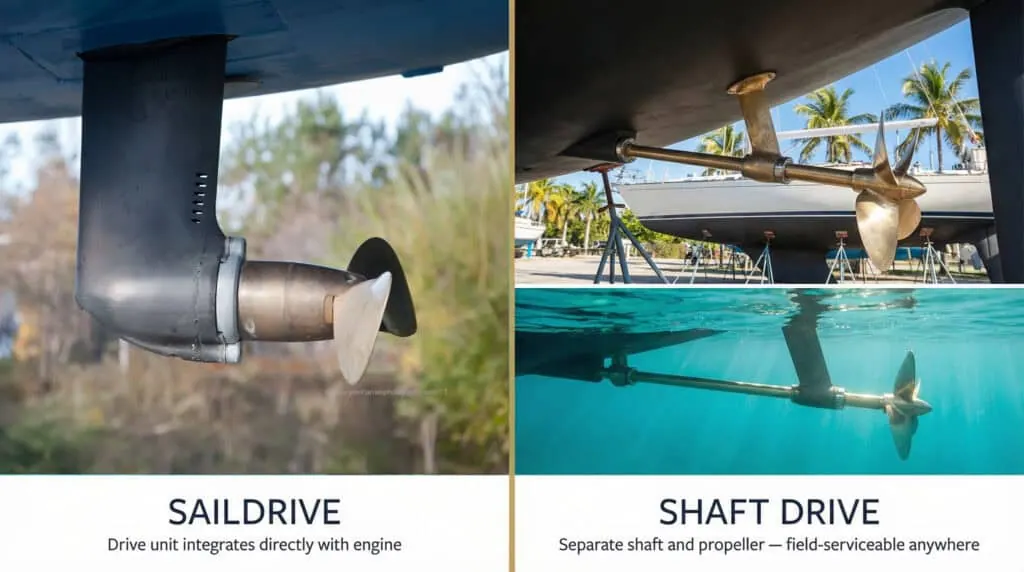
For bluewater cruising, shaft drives offer practical advantages that matter when you’re far from service facilities. Serviceability is the primary one: a shaft drive can be disassembled, repaired, or replaced using standard tools and universal parts available in virtually any port with a marine chandlery. Saildrives require manufacturer-specific parts and specialized knowledge — fine in the Mediterranean or Caribbean charter hubs, problematic in remote Pacific anchorages where the nearest dealer is a thousand miles away.
Both arrangements place seals at or near underwater penetrations, and neither is zero-risk. Saildrive manufacturers treat the rubber diaphragm as a hull-safety part with scheduled replacement — many Yanmar units pair dual diaphragms with a leak alarm — while shaft installations use a stuffing box or dripless seal that also requires inspection and periodic service. The practical difference is access: a shaft drive’s seals and working parts are inside the hull where you can reach them, while diaphragm service on a saildrive generally means hauling the boat.
The practical advantage for passages far from service yards is simple peace of mind. Standard parts, universal knowledge, and interior accessibility mean you can fix most shaft drive problems yourself. That’s not just convenience — it’s a safety margin when professional help is thousands of miles away.
The Enclosed Cockpit: Visibility and Protection
Most production catamarans use an open-stern cockpit design with helm stations at the aft end of the boat. This connects the helm to the social space and provides easy access to swim platforms — ideal for charter operations where guests want to move freely between interior and exterior.
The Antares cockpit is fully enclosed with wraparound windows providing visibility in all directions. The helm is positioned within this protected space, not exposed at the stern. This is a fundamentally different design philosophy.
Protection from the elements is the immediate benefit. The helmsman stays dry in rain, out of spray in rough seas, and sheltered from wind that can cause fatigue over long watches. Safety follows from this: no one gets washed off the helm by boarding waves or unexpected rolls. An exhausted helmsman can stay at the wheel longer and make better decisions — and fatigue, as we know, is itself a safety factor.
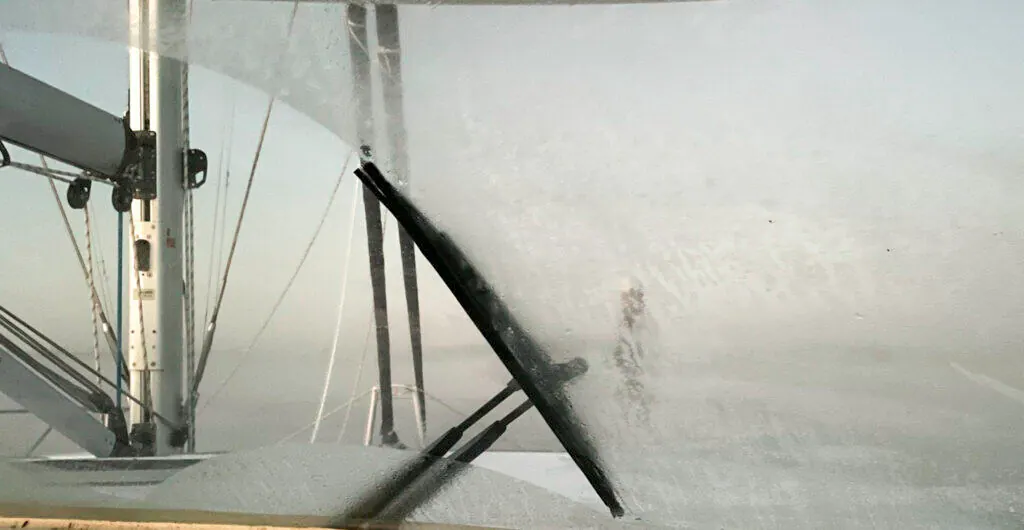
All-weather watchkeeping capability matters for offshore routing. When you need to hand-steer through a squall at 3 AM, doing so from a protected position with clear visibility changes the experience entirely. Communication between crew improves too — the helmsman can see and speak to everyone in the cockpit without shouting against wind noise or leaving the wheel to check on the crew.
You wouldn’t think of driving your car away from the curb without 100% steering confidence and clear visibility forward, but boaters seem to be less fussy. An aft helm station may offer a pleasant view at anchor, but try steering from the stern while the bows are pitching in heavy seas — note this ship is moving away from us despite the pointy bits. The ability to see where you’re going while steering from where you are is not, apparently, a universal priority.
Systems and Redundancy for Ocean Passages
The offshore systems philosophy is straightforward: “Two is one, one is none.” When you’re 1,000 miles from the nearest chandlery, redundancy isn’t luxury — it’s survival.
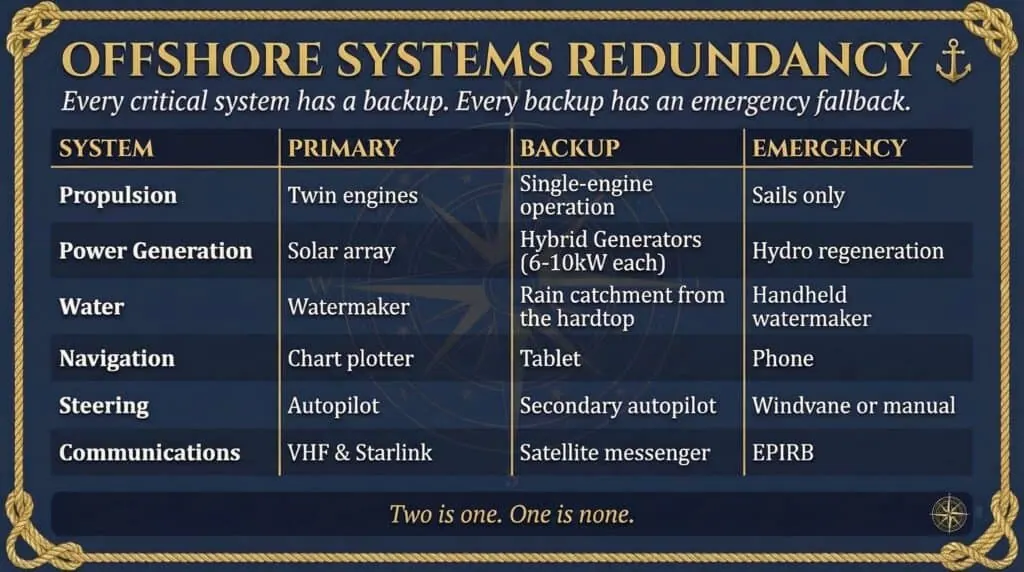
Essential dual systems:
Fuel system isolation: Twin engines must have completely independent fuel systems — separate tanks, separate lines, separate filters. A single contaminated fuel tank disables both engines on many production catamarans. True offshore boats allow you to run entirely on one side if the other is compromised.
Access for service: Before buying any catamaran, identify the location of these components with your eyes closed at 3 AM in rough seas: raw water pump for each engine, primary fuel filter, seacocks for each hull, bilge pump switches. If you need to disassemble furniture or empty lockers to reach these, that’s a design compromise that matters offshore.
Parts availability: Proprietary systems look impressive in brochures but create headaches in remote anchorages. Industry-standard components (Yanmar engines, Volvo pumps, generic electrical connectors) can be sourced in Tahiti, Grenada, or Durban. Custom systems cannot.
Hybrid/Electric: It is worth noting that hybrid-electric propulsion has moved from experimental curiosity to expected option for bluewater buyers in 2025-2026. The appeal is understandable — silent operation, reduced fuel dependence, and environmental considerations. Antares offers a hybrid option for those drawn to this technology.
The Buyer’s Evaluation Checklist
Use this checklist when evaluating any catamaran for bluewater cruising. A “no” to any mandatory item is a disqualifier, in my view.
Mandatory (Non-Negotiable)
- CE Category A certification (or equivalent ABS/Lloyd’s certification) — verify with documentation
- Documented structural engineering — not “built strong,” but calculated load paths and safety factors
- Bridge deck clearance verified for the model — judged at loaded displacement (not empty boat specs) against beam, tunnel shape, and the designer’s guidance, not a single universal number
- Twin engines with fully independent fuel systems — separate tanks, lines, filters
- Liferaft storage accessible from both hulls — not just stuffed in locker
- Stability documentation — the builder can show the ISO 12217-2 multihull assessment behind the CE rating: inversion susceptibility, inverted flotation, and escape provisions
Highly Desirable
- Proven circumnavigation track record — have multiple owners completed ocean crossings?
- Active owner community — who answers your questions at 2 AM mid-Pacific?
- Factory support for 10+ year old boats — can you still get parts and advice?
- Strong resale value in cruising markets — will someone buy it in Australia or the Caribbean?
FAQ: Answering the Questions That Arrive in My Inbox
Q: What is the best bluewater catamaran for a couple?
Catamarans in the 44-48 foot range suit most cruising couples. This size provides adequate tankage and storage for extended passages, standing headroom throughout, and manageable sail plans for two people. Smaller cats (under 42 feet) sacrifice tankage and comfort. Larger cats (50+ feet) may require professional crew or exhausting sail handling. For couples, prioritize easy reefing systems, electric winches, and a protected helm that allows single-handed operation while the other rests. So yeah, it’s relevant to you.
Q: What bridge deck clearance do I need for offshore sailing?
There is no single universal number, despite how often one is quoted. Published minimums are design heuristics: offshore designers work from proportion-based rules of thumb tied to length overall or the span between the hulls, then refine for beam, tunnel shape, and load — Ted Clements’ treatment of the geometry explains why the number is model-dependent. Generous, clean underwing clearance reduces slamming in sustained tradewind sea states. Always verify clearance for the specific model at loaded displacement (full fuel, water, provisions), not the empty-boat figures used in marketing.
Q: What is CE Category A certification?
CE Category A is the European Union’s “Ocean” classification for recreational vessels. It requires documented proof that a boat can handle Beaufort Force 8+ winds (40+ knots) and 4+ meter waves. The certification process includes stability analysis, structural engineering validation, righting moment calculations, and safety equipment integration testing. Category A is the only CE rating suitable for circumnavigation — Category B (“Offshore”) and C (“Inshore”) are insufficient for Pacific crossings.
Q: How much does a bluewater catamaran cost?
Quality bluewater catamarans range from $800,000 to $1.5 million for new vessels in the 44-48 foot range. Pre-owned bluewater cats start around $450,000 for 10-15 year old vessels from reputable builders. The $500,000–$800,000 range offers strong value — proven designs with depreciation absorbed but decades of service remaining. Budget an additional 15-20% of purchase price for offshore outfitting: safety equipment, spare parts, upgraded ground tackle, and passage provisions.
Q: What is a semi-custom catamaran?
A semi-custom catamaran is built to order with standardized hulls and decks but customizable interior layouts, finishes, and systems. Unlike production cats built on assembly lines in batches of 50+, semi-custom builders produce 3-8 boats annually, allowing individual attention to each vessel. Buyers typically select from pre-engineered layout options with custom finish specifications. This approach delivers build quality and personalization unavailable in mass production without the cost and complexity of full custom construction.
A Final Observation
Choosing a catamaran for ocean cruising is, I suppose, rather like choosing a spouse for a long voyage. The glossy brochure matters less than how the vessel behaves when conditions turn disagreeable. The right partner transforms daunting passages into manageable voyages. The wrong partner turns manageable weather into avoidable problems.
Suppose we designed from first principles: adequate bridge deck clearance, a protected helm station with proper visibility, a cockpit configured for conditions rather than entertaining, construction that survives the groundings that happen to everyone eventually, and systems that can be repaired with standard parts in remote anchorages.
You can enjoy fair weather sailing and still experience the open ocean in safety. Design with the possibility of extreme conditions in mind and compromise a little on the dockside flash. Isn’t that the only philosophy we can all live with?
If you’re researching bluewater catamarans and would like to explore what offshore-ready design looks like in practice, the Antares 44 and Antares 46 are built exclusively for bluewater cruising — CE Category A certified since 2007, designed by Ted Clements, and backed by over 20 years of offshore-only heritage. Enquiries welcome!
Published March 2026 | Certification details should be confirmed against the builder’s CE Declaration of Conformity for the specific model