
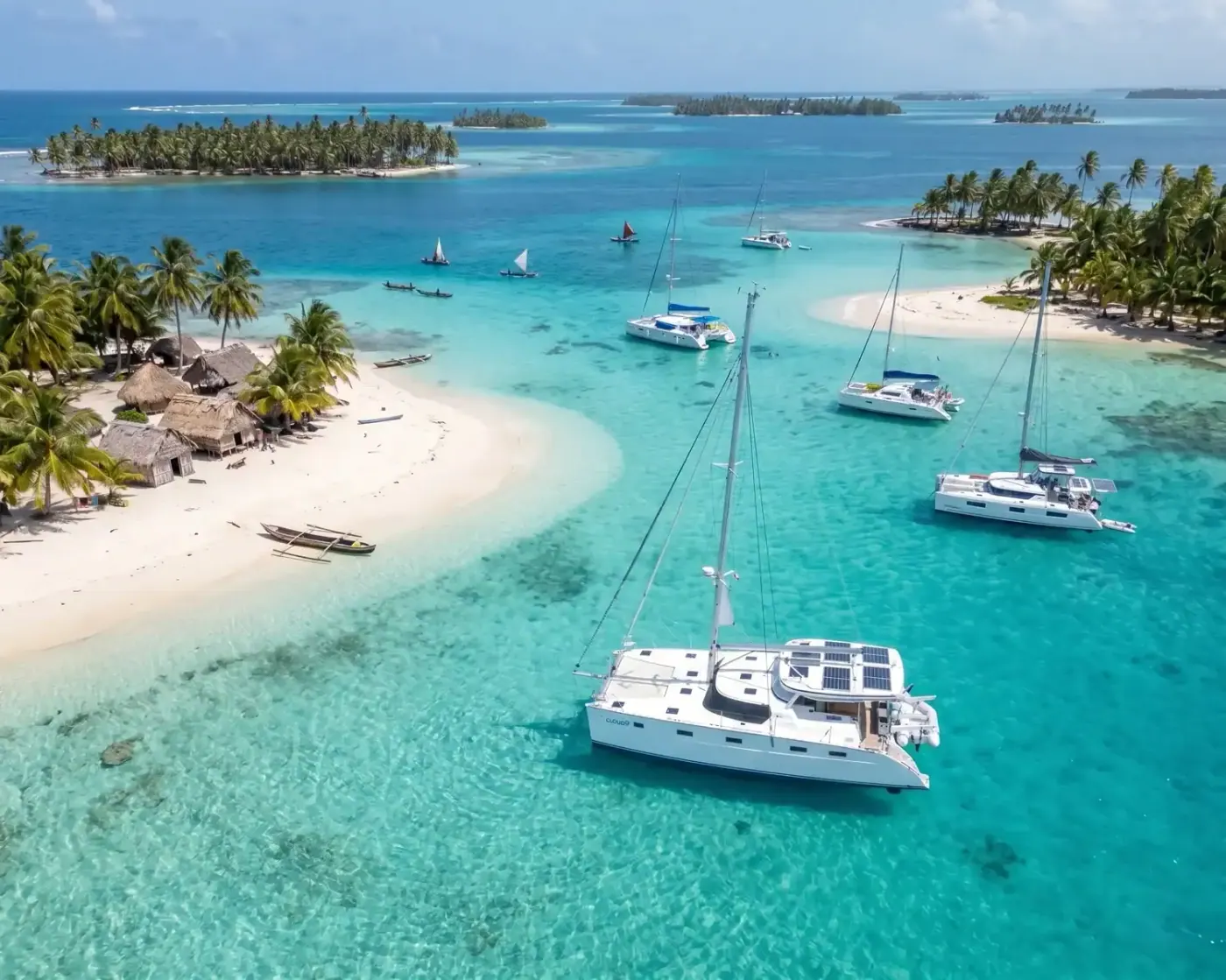
Hybrid propulsion needs to be evaluated around use, range assumptions, charging, redundancy, and support.
- The original hybrid guide is preserved below, including its terminology, buyer cautions, links, and comparison structure.
- Hybrid is not one specification. Buyers need the actual configuration, operating modes, charging path, and support model.
- Use the article to separate useful daily-life benefits from claims that need model-specific confirmation.
Captain’s Quick Summary
The short version: Hybrid propulsion on bluewater catamarans has moved from experimental curiosity to proven, deployable technology — but it’s not right for everyone. Here’s what this deep dive covers:
- The pushback is real. Critics aren’t wrong about everything — some early systems were “dreadfully unreliable.” We address those failures head-on and separate outdated concerns from current reality.
- 10 years of evolution (2015–2026). From Oceanvolt’s first install to Volvo Penta’s 2026 hybrid launch, the technology has matured dramatically.
- We offer two systems. Hybrid Marine and Integrel E-Drive with full specs and tradeoffs.
- Measured data, not marketing. Hydrogeneration: ~1kW at 8 knots, per motor. Fuel savings: 37% on real journeys. Battery life: 10–15 years with LFP cells.
- Independent validation. Practical Sailor featured an Antares 44 hybrid (“Lonna”) as its primary case study — that’s credibility you can’t buy.
- Honest limitations. $80k–$100k upfront premium. Battery replacement at 10-15 years ($15k–$25k). A hybrid can actually save ~500 lbs vs. a diesel due to reduced fuel carried.
Read the full deep dive below for the complete analysis, data, and decision framework.
Why this matters now: Hybrid catamaran propulsion has crossed a critical threshold. In April 2026, Volvo Penta launched its first fully integrated hybrid-electric IPS package. The world’s largest marine diesel manufacturer just jumped on board with a hybrid. Meanwhile, the marine hybrid market is projected to reach $7.07 billion by 2033 (8.8% CAGR). This technology has moved from experimental curiosity to mainstream reality.
But here’s the uncomfortable truth: for every sailor celebrating silent anchoring and fuel savings, there’s another who ripped their electric drives out and “threw them in the garbage” after repeated failures. The gap between marketing brochures and cruising reality has never been wider.
This isn’t a sales pitch. It’s a 10-year retrospective on marine hybrid evolution, a direct confrontation with the critics who call these systems “dreadfully unreliable,” and a data-driven framework for whether hybrid actually makes sense for your cruising profile. We’ve sourced everything — specific quotes, documented failures, measured regeneration data, and real fuel consumption figures from actual voyages. We’ve had over four years of experience, designing, building, and supporting parallel hybrids on our boats.
Let’s start with the skepticism. It deserves to be heard.
Why Critics Question Hybrid Catamaran Propulsion — Real Voices, Real Arguments
Marine hybrid systems have attracted vocal, technically literate opposition. These aren’t Luddites resisting change — they’re experienced cruisers, marine engineers, and publication editors who’ve witnessed failures firsthand. Their arguments carry weight because they’re grounded in real-world failures rather than theoretical objections.
The “Complexity Trap” — Passagemaker’s Critique
In their technical analysis “The Science of Hybrid Propulsion: The Great Debate,” Passagemaker magazine didn’t mince words:
“Dreadfully unreliable and ridiculously complicated.”
That’s the exact phrasing they used to describe early hybrid installations. The publication — authoritative within the trawler and long-distance cruising community — has documented multiple cases in which the theoretical elegance of hybrid systems collapsed under the practical demands of remote cruising.
One marine specialist reported supervising the removal of a hybrid system from a 70-foot yacht specifically because it was unserviceable in remote locations. When your nearest qualified technician is 2,000 nautical miles away, complexity isn’t an inconvenience — it’s a voyage-ending liability.
The Hybrid Inefficiency Argument
Some sailors have long pointed out a fundamental thermodynamic problem with the series-hybrid architecture: dual conversion losses. When you run a diesel generator to power an electric motor for long-distance motoring, you suffer energy loss at every conversion. However, the upfront assumptions don’t always consider that the diesel engines are running at peak efficiency – Brake Specific Fuel Consumption (BSFC) while generating DC current. Here is a table comparing the efficiencies of each propulsion type.
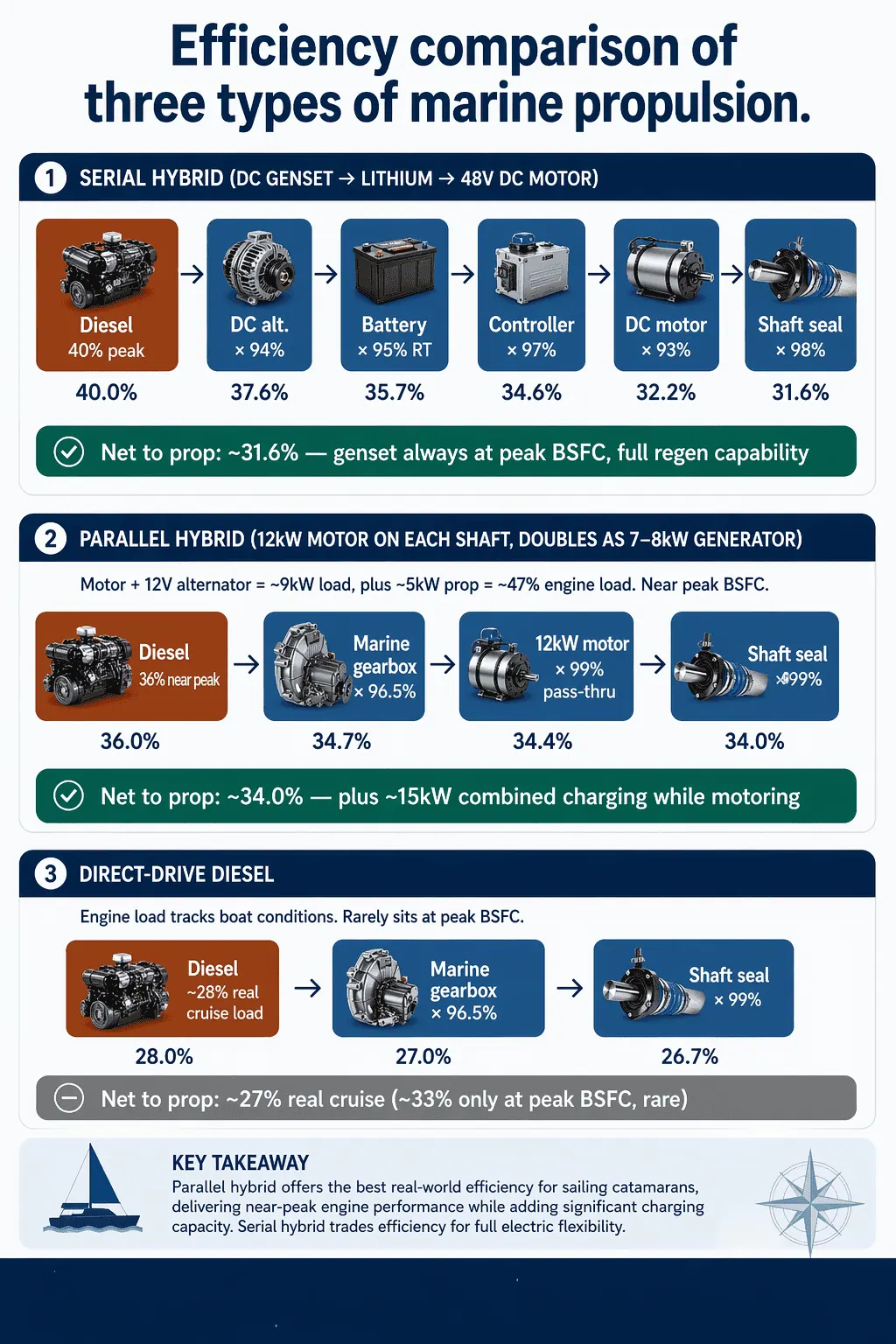
The result? For extended motoring, a hybrid catamaran propulsion system can be more efficient than a direct-drive diesel. This is contrary to the typical efficiency arguments tossed around.
The Torqeedo Failure Pattern
On Cruisers Forum and BoatDesign.net, a disturbing pattern emerged among Torqeedo electric outboard and pod drive owners. Multiple users reported:
“5 failed units in 6 months.”
This wasn’t isolated grumbling. It was a documented failure rate that would be unacceptable in any marine context. One detailed account described an owner removing E-Pod electric drives entirely and — in the owner’s own words — “throwing them in the garbage” after repeated reliability issues made the system more of a liability than an asset.
The pattern was consistent: early electric pod drives, marketed for their simplicity, proved vulnerable to saltwater intrusion, thermal management failures, and corrosion of controller electronics. When your propulsion fails 500 miles from land, “innovative” becomes a dirty word.
The Underpowered Motor Problem
Early serial hybrids — most notoriously the Lagoon 420 Hybrid (2006-2009) — were underpowered. The electric motors simply couldn’t generate enough thrust to maintain steerage way in challenging conditions. Owners reported “range anxiety” when facing 20-knot headwinds and sea slop, where the electric motors couldn’t maintain control.
The problem wasn’t just range — it was safety. A catamaran that can’t make headway in adverse conditions is a liability, not a cruising vessel. The Lagoon 420 Hybrid was quietly discontinued, becoming a cautionary tale that haunted hybrid marketing for a decade.
Why These Critics Matter
Here’s what the critics get right: early hybrid systems were often poorly engineered, oversold, and under-supported. The gap between laboratory testing and ocean cruising is vast. Salt spray, vibration, temperature extremes, and the absolute necessity of reliability in remote anchorages — these factors expose design flaws that dock testing misses.
But here’s what the critics sometimes miss: the technology has evolved significantly. The failures of 2010-2015 aren’t necessarily predictive of 2026 systems. Battery chemistry has transformed. Controller electronics have hardened. Installation practices have professionalized. And critically, parallel hybrid architecture addresses many of the efficiency and reliability concerns that plagued early series hybrids.
The question isn’t whether early hybrids failed. They did. The question is whether modern systems — installed correctly, specified appropriately, and maintained properly — can deliver on the promise. That’s what the rest of this guide examines.
A Brief History: 10 Years of Marine Hybrid Evolution (2015-2026)
To understand where hybrid catamaran propulsion stands today, you need to understand how we got here. The marine hybrid story isn’t a straight line — it’s a series of technological bets, market corrections, and incremental improvements that collectively transformed a novelty into a viable option.
The Early Pioneers (Pre-2015)
Oceanvolt — founded in 2004 in Finland — was the true pioneer. They developed the ServoProp, a saildrive with a controllable pitch propeller that could switch between propulsion and regeneration. Early successes included the Aventura 33 (2013/2015), proving that electric propulsion could work on small cruising vessels.
Hybrid Marine International (a division of Barrus Ltd) took a different approach. Rather than pure electric, they developed parallel hybrid systems — electric motors integrated onto the shaft of conventional diesel engines. This architecture allowed captains to choose: diesel-only for long passages, electric-only for short hops and harbor maneuvering, or a combination of both depending on the circumstances. Their systems became standard options for Antares and other bluewater brands.
Fischer Panda established the “generator-centric” series hybrid foundation with high-efficiency DC generators and “EasyDrive” systems. Their approach — using a diesel generator as the primary power source for electric motors — became common in early serial hybrid installations, though it would later draw criticism for conversion inefficiency.
The Battery Revolution (2015-2019)
The most significant transformation in marine hybrid wasn’t the motors — it was the energy storage.
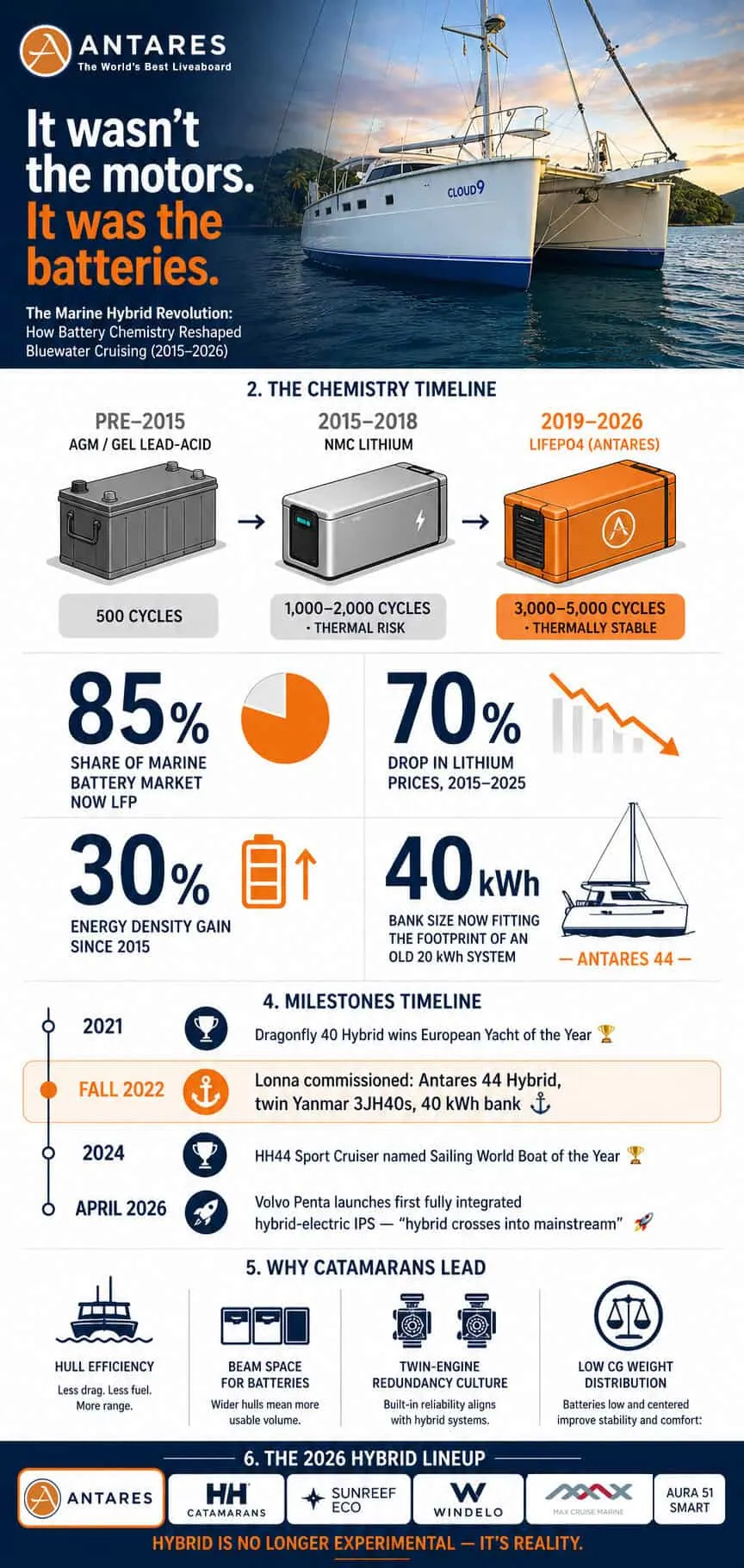
2015-2018: The transition from heavy AGM/Gel lead-acid banks to early Lithium-Ion (NMC) represented a 3x improvement in energy density. But NMC chemistry had problems: thermal runaway risks, shorter cycle life (1,000-2,000 cycles), and sensitivity to overcharging.
2019-2026: The dominance of Lithium Iron Phosphate (LiFePO4/LFP) changed everything. LFP now accounts for approximately 85% of the marine battery market due to:
- Safety: Thermal stability — no thermal runaway, no fire risk
- Cycle life: 3,000-5,000 cycles to 80% capacity (vs. 500 for lead-acid)
- Cost reduction: Prices dropped 70% between 2015 and 2025
Energy density improvements of approximately 30% since 2015 now allow 40kWh+ banks (like those in the Antares 44) to fit in the same footprint as older 20kWh systems. This matters because regeneration physics demand substantial battery banks to absorb peak generation loads.
Key Milestones and Market Validation
2021: The Dragonfly 40 Hybrid wins European Yacht of the Year, validating hybrid trimarans for performance cruising. This was the first major industry award recognizing hybrid propulsion as a genuine performance advantage, not a compromise.
Fall 2022: Commissioning of Lonna (Antares 44 Hybrid) — the vessel that would become the most documented parallel hybrid installation in bluewater cruising. Twin Yanmar 3JH40 diesels, 40kWh lithium bank, Hybrid Marine International system. This was not experimental; it was a production vessel with owners planning a circumnavigation.
2024: The HH44 Sport Cruiser (Parallel Hybrid) is named Sailing World’s Boat of the Year. Performance catamaran builders — traditionally conservative about weight and complexity — embraced hybrid as a performance enhancer.
April 2026: Volvo Penta launches its first fully integrated hybrid-electric IPS package. When the world’s largest marine diesel manufacturer — the company that powers everything from bayliners to superyachts — commits to hybrid, the technology has crossed from experimental to mainstream. This “big diesel” entry signals that hybrid isn’t a sideshow; it’s the future of marine propulsion.
Adoption Trajectory on Catamarans Specifically
Catamarans have become the proving ground for hybrid catamaran propulsion for several reasons:
- Hull efficiency: Twin hulls with long waterlines generate more efficient hydrogeneration than monohulls
- Space: Wide beams accommodate battery banks without compromising living space
- Redundancy culture: Catamaran buyers already expect twin engines; hybrid adds options without violating redundancy expectations
- Weight distribution: Battery banks positioned low in hulls improve stability
By 2026, hybrid options are available from Antares, HH Catamarans, MaxCruise Marine, Sunreef (Eco series), Windelo, Fountaine Pajot (Aura 51 Smart Electric), and Leopard (46 Hybrid). The technology has moved from boutique custom installations to production line options.
Where Hybrid Delivers — Real Benefits with Real Data
Against the backdrop of skepticism and historical failures, where do modern hybrid systems actually deliver measurable value? The answer, based on documented data from actual installations: silent operation, fuel efficiency in specific scenarios, reduced engine hours, and hydrogeneration. Let’s examine each with specific numbers.
Silent Maneuvering — The Understated Advantage
This isn’t subjective. Decibel meters don’t lie. When operating in electric mode, hybrid catamarans produce under 40 dB — comparable to a quiet library. Conventional diesel operation produces 65-75 dB — the difference between conversation and shouting.
The practical impact:
- Harbor maneuvering: You can actually hear crew instructions, dock lines being handled, and other vessels
- Early morning departure: No waking the entire anchorage at 0600
- Wildlife observation: Approach marine mammals without engine noise, driving them off
- Conversation: Normal-volume discussion while underway — no more shouting over engine roar when inside or outside the boat
The silence isn’t just a luxury — it’s situational awareness. In crowded anchorages, being able to hear other vessels, crew calls, and environmental sounds is a genuine safety enhancement.
Fuel Efficiency — The Documented Numbers
Here’s where data matters more than marketing claims. Integrel Solutions conducted controlled testing comparing different motoring configurations on a 50-foot performance catamaran. The results:
28nm journey at 6.2 knots:
- Twin diesel operation: 8.5 gallons consumed
- Single diesel + single electric (hybrid): 5.3 gallons consumed
- Fuel savings: 37% reduction
The mechanism: one diesel running at optimal load (1,500-2,000 RPM) is more efficient than two diesels running at partial load. The electric motor provides the second hull’s thrust without combustion inefficiency. At moderate speeds (5-7 knots typical of coastal cruising), this hybrid configuration delivers genuine fuel savings.
Theoretical range extension:
- Single 40hp Yanmar in hybrid setup at 1,500 RPM (5.0 knots): ~1,100nm range
- Twin diesels at same speed: ~700nm range
The caveat: These savings apply primarily to moderate-speed cruising. At maximum speed (8+ knots), the diesel operates closer to optimal load, and the hybrid advantage diminishes. For long passages where you’re running both engines at 2,200+ RPM, the efficiency gains are minimal.
Reduced Engine Hours — Longevity Economics
Diesel engines have finite lifespans measured in hours. A typical marine diesel is rated for 5,000-8,000 hours before major overhaul. For active cruisers running 500-800 hours annually, this means major maintenance every 7-10 years.
Hybrid operation reduces diesel engine hours by shifting low-load operation to electric:
- Harbor maneuvering: 30-60 minutes per port visit — typically 50-150 hours annually for active cruisers
- Anchor approach/departure: 15-30 minutes daily — 90-180 hours annually
- Short hops: Any transit under 2 hours — variable by cruising pattern
For a typical cruising couple visiting 30-40 anchorages annually, electric operation can reduce diesel hours by 200-400 hours per year. Over a 10-year ownership period, that’s 2,000-4,000 fewer diesel hours — potentially extending major overhaul intervals by years.
The economic calculation: If major diesel overhaul costs $15,000-25,000 per engine, deferred maintenance represents genuine value. Plus reduced oil changes, filter replacements, and routine service.
Hydrogeneration — The Physics and the Reality
This is where marketing and reality diverge most dramatically. Brochures suggest “extended range through regeneration.” The actual physics are more constrained.
Antares 44 Hybrid measured data:
- 6-7 knots boat speed: ~500W generation per prop
- 8 knots: ~1kW generation per prop
The critical caveat: Below 5 knots boat speed, hydrogeneration is negligible — under 100W. In light winds where your catamaran is doing 3-4 knots, the regeneration is essentially zero. You need boat speed to generate power, and boat speed requires wind.
Practical calculation: A 40kWh battery bank (typical Antares hybrid installation) requires:
- At 9 knots sailing (2kW generation): 15+ hours to fully recharge from 80% DOD
- At 8 knots sailing (1kW generation): 40 hours to fully recharge
This means hydrogeneration is effective for maintaining charge during multi-day passages — not for rapid recharging after electric motoring. On a tradewind passage with steady 15-20 knot winds pushing you at 8-9 knots, you’ll see meaningful regeneration. In light variable conditions, don’t count on it.
The practical takeaway: Hydrogeneration extends electric range but doesn’t eliminate the need for shore power or generator charging in real-world cruising. It’s a supplement, not a solution.
House Power Independence — Air Conditioning Without the Generator
One underappreciated benefit: substantial lithium battery banks enable overnight air conditioning without running a diesel generator.
Lonna (Antares 44) configuration:
- 40kWh lithium bank
- 12,000-16,000 BTU air conditioning in main salon, with independent AC Units in each aft cabin
- Silent overnight operation: 6-8 hours on battery power alone
- Recharge via: solar (400-600W typical), hydrogeneration (when sailing), or brief generator run
For tropical cruisers, this transforms the anchoring experience. No generator noise is disturbing the anchorage. No exhaust fumes. No 0200 generator startup when the cabin gets stuffy. Just silent air conditioning through the night.
The limitation: Heavy air conditioning use requires substantial battery capacity and recharge planning. But for moderate climates or intermittent use, it’s a genuine lifestyle upgrade. Adding solar is critical. An Antares 44 Hybrid upgraded its solar to 5kW of hard panels. Their daily output is over 20kW/day!
Third-Party Validation: Practical Sailor and the Lonna Case Study
Industry publications have approached hybrid with appropriate skepticism. Practical Sailor — known for no-nonsense technical analysis without advertising influence — examined hybrid viability in their article “Do Hybrid Propulsion Systems Make Sense on Small Boats?”
Their conclusion: all-electric propulsion remains impractical for most cruisers due to range limitations, but parallel hybrid systems offer a viable middle path.
The Lonna Case Study
Practical Sailor highlighted Lonna — the Antares 44 commissioned in December 2022 — as a proof-of-concept for parallel hybrid on small-to-midsize cruisers. The vessel specifications:
- Vessel: Antares 44 catamaran
- Commissioned: December 2022
- Engines: Twin Yanmar 3JH40 hybrid diesels
- Battery bank: 40kWh lithium
- System: Hybrid Marine International parallel hybrid
- Case study documentation: Hybrid Marine International case study
The Practical Sailor assessment emphasized that, unlike all-electric systems (which they found inadequate for cruiser-range requirements), the parallel hybrid delivers “the best of both worlds” — silent electric operation for the first 10 miles and harbor maneuvers, with the security of twin-diesel capability for offshore safety.
Critical insight from the article: The parallel hybrid’s ability to eliminate the standalone diesel generator (by using the propulsion engines as generators at anchor) simplifies the overall engine room footprint and dramatically reduces noise. Instead of a separate 5-8kW generator running continuously for house loads, the main engines provide generator function when needed — and the substantial battery bank handles the rest.
This third-party validation matters because Practical Sailor has no commercial relationship with Antares or Hybrid Marine. Their assessment is based on technical analysis, not marketing partnership. When they conclude that parallel hybrid “makes sense” for small boats — with appropriate caveats about cost and complexity — it carries weight.
The Limitations of Hybrid Catamaran Propulsion
No technology is perfect. Hybrid systems carry genuine limitations that prospective buyers must understand before committing. This section isn’t about dampening enthusiasm — it’s about ensuring expectations align with reality.
Battery Degradation — The Long-Term Reality
Modern marine LFP (LiFePO4) batteries are rated for 3,000-5,000 cycles to 80% capacity (SOH — State of Health). For a typical cruiser, this translates to:
- Heavy use: 300-350 cycles annually = 8-12 year lifespan
- Moderate use: 200-300 cycles annually = 10-15 year lifespan
- Light use: 100-200 cycles annually = 15-20 year lifespan
Marine-specific factors that accelerate degradation:
- Salt spray: Accelerates self-discharge and terminal corrosion
- Temperature: Sustained operation above 35°C reduces cycle life
- Depth of discharge: Regular 100% discharge vs. 80% discharge significantly impacts longevity
- Charging practices: Poorly configured chargers cause cell imbalance
The practical reality: A 40kWh lithium bank represents a $15,000-25,000 investment that will require replacement after 10-15 years of typical use. This isn’t a hidden cost — it’s a scheduled maintenance item that should be factored into long-term ownership economics.
Comparison to lead-acid: AGM/Gel batteries typically last 3-5 years in marine use (300-500 cycles). LFP’s 10-15-year lifespan is significantly longer, but not infinite. The cost-per-cycle economics favor lithium, but the upfront investment is substantial.
Upfront Cost Premium — The Investment Reality
Hybrid systems add significant cost to base vessel pricing. Current market data (2026):
- Hybrid system premium: $35,000-65,000, depending on configuration
- Battery bank (40kWh LFP): $15,000-25,000
- Total additional investment: $50,000-90,000 over a conventional twin diesel
Return on investment calculation:
- Fuel savings: 20-37% on typical cruising (variable by use pattern)
- Reduced maintenance: Extended diesel overhaul intervals, fewer oil changes
- Resale value: Premium for hybrid-equipped vessels increasing as technology mainstreams
- Break-even: 7-12 years for typical cruisers (highly variable)
The practical takeaway: Most hybrid buyers aren’t making the decision on pure financial ROI. They’re prioritizing silent operation, environmental considerations, and technological preference. The economics matter, but they’re rarely the primary driver.
Remote Serviceability — The Cruising Constraint
This is the concern that nearly killed hybrid adoption in bluewater cruising. The Passagemaker critique about systems being “unserviceable in remote locations” remains valid for certain configurations.
Serviceability factors:
- Diesel engines: Yanmar mechanics exist in most cruising destinations worldwide
- Electric motors: Simpler than diesels — brushless permanent magnet motors have minimal maintenance requirements
- Controllers/inverters: The vulnerability point. Sophisticated power electronics require specialized diagnostics
- Battery management systems: Critical and complex — failure can disable the entire system
Mitigation strategies:
- Parallel architecture: If the hybrid system fails, you still have conventional diesel propulsion
- Redundant systems: Quality installations include bypass capability and backup control
- Spare parts inventory: Carry critical controllers, contactors, and BMS components
- Remote diagnostics: Modern systems include satellite-connected monitoring for troubleshooting
The reality: A hybrid catamaran in the Tuamotus or Patagonia requires more self-sufficiency than a conventional diesel vessel. The question isn’t whether hybrid is serviceable everywhere — it’s whether the owner is prepared for the additional complexity and spare parts burden.
Hybrid Catamaran Propulsion vs. Diesel — The Decision Framework
The choice between hybrid and conventional diesel isn’t about which technology is “better.” It’s about which technology matches your specific cruising profile, risk tolerance, and priorities. Here’s a decision framework based on actual use cases.
Choose Hybrid If:
- You prioritize silent operation: Harbor maneuvering, early departures, and wildlife observation matter to you
- You value reduced maintenance: Two verus three diesels to maintain, extended diesel overhaul intervals and fewer oil changes appeal to you
- Air conditioning independence matters: Silent overnight A/C without generator noise is a priority
- You’re prepared for the learning curve: Willing to understand battery management, regeneration optimization, and system monitoring
- Financial premium is acceptable: The $50,000-95,000 additional investment fits your budget without compromising other priorities
- You value factory integration: Antares factory-installed systems with warranty support matter more than lowest initial cost
- Environmental considerations influence your decisions: Reduced fossil fuel consumption and zero-emission operation in sensitive areas align with your values
Choose Conventional Diesel If:
- You prioritize absolute simplicity: Fewer systems to understand, maintain, and potentially fail
- Remote cruising is your primary plan: Circumnavigation with minimal support infrastructure
- You’re not technically inclined: Uncomfortable with battery management systems, power electronics, and software interfaces
- Budget constraints are tight: The hybrid premium would compromise other essential equipment
Installation Quality — Why It Matters for Hybrid Catamaran Propulsion
The research is clear: installation quality determines hybrid success or failure more than brand selection. A premium Integrel or Hybrid Marine system poorly installed will fail more catastrophically than a mid-tier system installed by experts with proper quality control.
Factory Integration Advantages
Antares factory hybrid installations offer:
- Engineering validation: Hull structure, weight distribution, and electrical system designed for hybrid from the start
- Warranty coverage: Single-point responsibility for system integration — not finger-pointing between component vendors
- Quality control: Consistent installation practices, tested before delivery
- Documentation: Complete system schematics, operation manuals, and maintenance protocols
- Support infrastructure: Factory-trained technicians familiar with the specific installation
The Lonna case study demonstrates factory integration value: commissioned in December 2022, the vessel has operated without significant hybrid system issues through multiple years of active cruising. This isn’t luck — it’s an engineering discipline.
Aftermarket Installation Risks
Post-delivery hybrid installations face challenges:
- Structural modifications: Battery banks require secure mounting, ventilation, and sometimes hull reinforcement
- Electrical integration: Existing vessel electrical systems may not support high-current battery charging/discharging
- Weight distribution: Adding 500+ lbs of batteries without compromising trim and stability
- Multiple vendors: Battery supplier, motor supplier, controller supplier — integration responsibility unclear
The Passagemaker critique of “dreadfully unreliable” systems often stems from aftermarket installations where integration was under-engineered. When the battery management system fails to communicate with the motor controller because the installer used incompatible CAN bus protocols, that’s not a technology failure — it’s an integration failure.
Red Flags in Any Installation
Whether factory or aftermarket, avoid installations with these characteristics:
- Undersized battery banks: Less than 20kWh for a 40+ foot catamaran — insufficient for meaningful electric operation
- Non-marine components: Automotive or RV batteries, inverters, or controllers not rated for marine environment
- Inadequate ventilation: Battery banks and power electronics require active cooling — passive ventilation is insufficient in tropical climates
- No bypass capability: System must allow pure diesel operation if hybrid components fail
- Missing monitoring: No real-time battery state-of-charge, regeneration rates, or system health displays
- Vague warranty terms: “We’ll take care of it” without written coverage periods and response commitments
Contact Antares Catamarans: sales@antarescatamarans.com to discuss whether hybrid propulsion fits your bluewater cruising plans.
Still Deciding?
We don’t believe hybrid is the right answer for every sailor. Our team has walked dozens of prospective owners through this exact decision, and we’ll give you straight answers — no sales pitch, no pressure. Tell us how you plan to use your Antares, and we’ll tell you honestly whether hybrid makes sense for you.
Frequently Asked Questions: Hybrid Catamaran Propulsion
These are the questions we hear most from prospective Antares owners weighing hybrid vs. diesel.
How long do hybrid marine batteries last?
Lithium Iron Phosphate (LFP) marine batteries typically last 3,000-5,000 charge cycles, translating to 10-15 years of regular cruising use. At the end of life, they retain approximately 80% of their original capacity rather than failing completely. Replacement cost: $15,000-$25,000 for a full bank — budget this as a 10-year maintenance item, similar to standing rigging replacement.
Does a hybrid catamaran actually save fuel?
Real-world testing shows approximately 30%+ fuel savings on mixed-use journeys compared to twin diesel operation. On passages with consistent wind for regeneration, savings can be higher. On long motoring stretches (through calms or the Intracoastal Waterway), fuel savings are minimal — the hybrid’s efficiency advantage is in short bursts, not continuous operation.
How much does a hybrid add to the cost of an Antares?
The upfront premium is approximately $95,000 over a conventional diesel configuration, depending on battery capacity and system choice. Over a 10-year ownership period, fuel savings and reduced engine hours may offset part of this, but most owners choose hybrid for the operational experience — silent maneuvering, reduced generator runtime, off-grid autonomy — rather than direct financial ROI.
Can a hybrid Antares run on diesel alone?
Yes. Parallel hybrid systems like those offered by Antares can operate exclusively on diesel fuel — the electric system is optional. If any hybrid component fails, the diesel engine still drives the propeller shaft directly. This is a critical advantage over series-hybrid or pure-electric systems, where a single point of failure can leave you without propulsion.
How much power can regeneration actually produce?
Measured data from Oceanvolt installations:
• At 6-7 knots: approximately 500 watts per hull
• At 8 knots: approximately 1kW per hull
• At 10 knots: approximately 3kW per hull
This is enough to cover house loads (refrigeration, instruments, navigation lights, charging) on a tradewind passage — and can eliminate generator use entirely. One Antares 44 hybrid owner completed a 21-day Pacific passage without starting their generator once.
Are hybrid catamarans heavier than diesel?
Counterintuitively, no. A well-designed parallel hybrid system can weigh approximately the same as a twin diesel installation. The removal of the generator offsets the increased weight in the electric motors and additional lithium batteries.
Sources and Further Reading
- Practical Sailor: “Do Hybrid Propulsion Systems Make Sense on Small Boats?”
- Hybrid Marine International: Lonna Antares 44 Case Study
- Oceanvolt: Hydrogeneration Technical Data
- Integrel Solutions: Intelligent Hybrid Motoring Performance Analysis
- Passagemaker: “The Science of Hybrid Propulsion: The Great Debate”
Published: April 2026 | Technical specifications and pricing current as of publication date. Market conditions and product availability are subject to change. Contact Antares Catamarans for current configuration options and pricing.