
Outfitting should be judged by reliability, service access, safety, storage, and how the boat will actually cruise.
- The original outfitting guide is preserved below with its systems, upgrades, and world-cruising preparation logic.
- Useful upgrades reduce risk or daily friction. Weak upgrades add cost, weight, complexity, or maintenance without changing the cruising plan.
- Use the article to separate must-have bluewater preparation from nice-to-have equipment that can wait.
The Captain’s Summary: Transitioning from coastal cruising to full-time liveaboard sailing requires a shift in mindset regarding systems, safety, and independence. This guide details the specific, battle-tested modifications that transform a standard luxury catamaran into a self-sufficient global explorer.
Key Takeaways
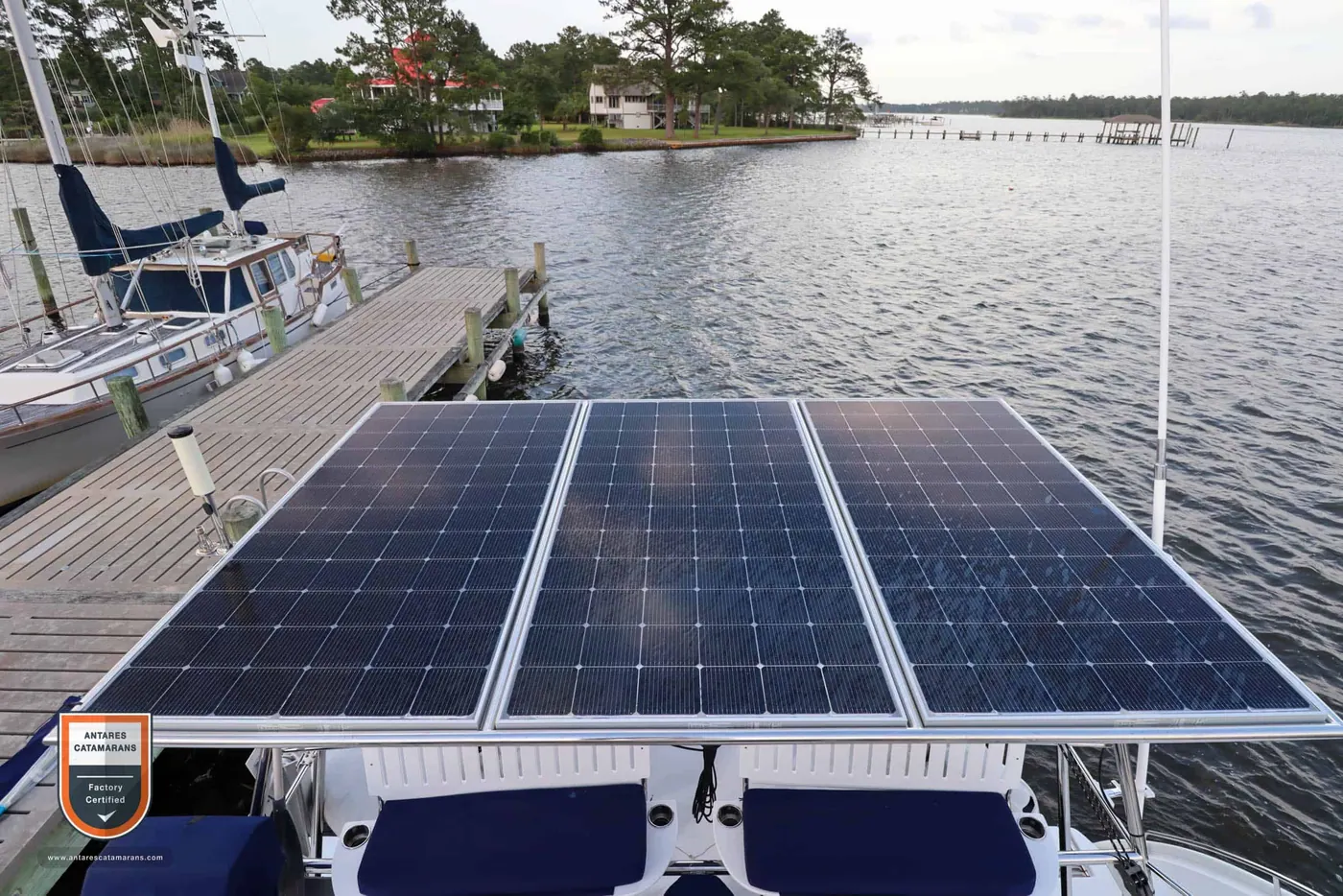
- Energy Independence: Combining high-wattage solar arrays (2kW+) with hydro-generators eliminates reliance on diesel generators.
- Advanced Safety: Redundant bilge monitoring and dry-bilge systems prevent moisture damage and provide early warning.
- Expedition Readiness: Onboard dive compressors and extended ground tackle prepare you for remote Pacific atolls and deep Mediterranean anchorages.
- Galley Heat Management: 12V exhaust systems are critical for maintaining salon comfort in tropical climates.
Achieving True Energy Autonomy
The modern luxury sailor demands silent power. A generator is a common backup. However, the goal for an Antares is to mainly use renewable energy. The more solar and lithium capacity on your boat – the better.
Solar Optimization
Unlike mass-production cats with limited bimini space, the rigid Antares hardtop allows for significant solar expansion. Owners frequently upgrade to 2,000 to 3,000 watts of solar capacity. This requires utilizing the full surface area of the hardtop, and extending capacity aft. With this capacity, you can run essential systems, including watermakers and refrigeration, purely on solar gain during peak hours.
Hydro-Generation
For long passages, solar often falls short during night operations when radar, chart plotters, and autopilots consume significant amperage. A transom-mounted hydro-generator, like the Watt & Sea, is the best choice for fast sailing if you don’t have a hybrid. The Antares Hybrid Marine solution offers hydrogeneration as standard.
Performance: At hull speeds above 7 knots, these units can generate 35 to 40 amps.
Efficiency: This output essentially covers the boat’s night-time consumption, keeping battery banks topped up without starting an engine.
Blue Water Safety and Bilge Management
Keeping water on the outside of the hull is rule number one. However, internal moisture management is equally vital for the longevity of the vessel and the health of the crew.
The “Dry Bilge” Standard
Standard float switches leave residual water in the bilge, which can lead to odors and humidity. Installing a dedicated vacuum bilge system, like Arid Bilge, uses small tubes to remove all moisture. It works in the main bilges, engine rooms, and generator lockers.
Redundant Alarms
Do not rely solely on the factory high-water alarm. A prudent captain installs independent, battery-operated water sensors in critical areas:
Watermaker Locker: High-pressure pumps can develop leaks that standard bilge pumps may not catch immediately.
Forward Watertight Bulkheads: In heavy seas, immediate notification of a hatch seal failure is critical.
Expedition Capability: Diving and Storage
Exploring the underwater world is a primary draw for the luxury buyer. The Antares is uniquely designed to support this without cluttering the living space.
Onboard Air Systems
Reliance on shore-based dive shops limits your range. Installing a dive compressor is essential for Pacific cruising.
Electric vs. Petrol: Electric units (Brownie or Bauer) are preferred. They can be hardwired into the boat’s AC system and run off the generator or, with a soft-start capacitor, the inverter.
Intake Logic: For cleaner fills and faster cooling, route the compressor intake from an air-conditioned cabin rather than hot, humid deck air.
Tank Management
Storage on a catamaran must account for weight distribution and accessibility. The Antares aft lockers accommodate 60-liter aluminum tanks perfectly. These are lighter and sufficient for recreational depths, avoiding the bulk of standard 80-liter steel tanks.
Galley and Interior Comfort
Liveability is defined by temperature control and ease of use.
Heat Extraction
Cooking in the tropics introduces unwanted heat into the salon. A dedicated 12V exhaust fan with an external vent is a superior upgrade. By venting heat outside instead of recirculating it, you lessen the load on air conditioning. This helps keep the main cabin comfortable while at anchor.
Custom Flooring
While teak-and-holly soles are stunning, they can be slick and prone to wear during ocean crossings. Custom-fitted, removable carpeting or runners with non-skid backing protect the wood and provide traction. Crucially, these must be cut to allow immediate access to floorboard pull-up rings for engine and bilge inspection.
Anchoring and Mooring for the Med
Rigging a boat for the Caribbean is different than rigging for the Mediterranean.
Med-Mooring configurations
When cruising Europe, you will often encounter deep anchorages and “stern-to” marina requirements.
Extended Chain: Upgrade primary ground tackle to 85m or 100m of chain. This allows for safe anchoring in 20m+ depths common in the Greek Isles and Turkey.
The Gangplank (Passerelle): A stern-mounted gangplank is mandatory for Med mooring. Using the Antares topping lift to hold the passerelle makes it easy to set up. It also keeps the transom safely away from the quay wall.
Surge Protection: Use strong mooring springs or rubber snubbers. They help reduce shock loads on cleats when securing stern-to in different surge conditions.
Technical Specifications for Upgrade Sizing
| System | Recommended Spec | Captain’s Note |
|---|---|---|
| Solar Array | 2000W – 3000W | Utilize hardtop surface; enables off-grid watermaking. |
| Hydro-Generator | Watt & Sea (or equiv) | Expect ~40 Amps at 8+ knots boat speed. |
| Dive Tanks | 60 Liter Aluminum | Fits standard aft lockers; lighter for handling. |
| Anchor Chain | 85m – 100m | Essential for deep-water Mediterranean or S. Pacific anchorages. |
| AC Voltage | 110v/220v Capability | Install Victron Skyla or Isolation Transformers for global power compatibility. |
Conclusion
A luxury catamaran is a platform for independence. By implementing these specific upgrades—ranging from robust energy production to advanced safety sensors—you transform the vessel into a true circumnavigator. The Antares is built to seamlessly accommodate these systems, ensuring your journey is as safe as it is comfortable.