
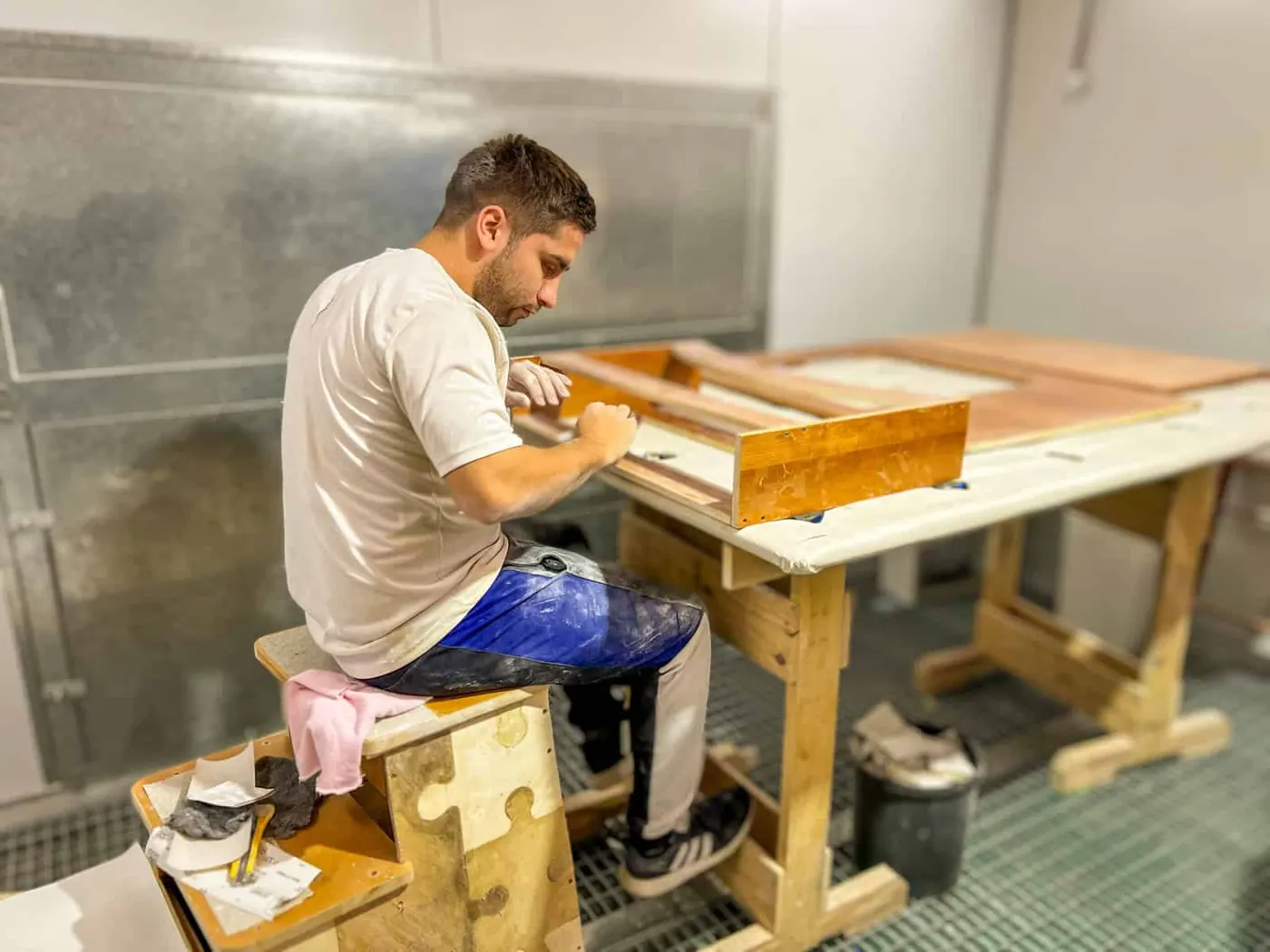
Measured production is about attention, communication, and owner trust.
- The original WordPress article is preserved below with its build philosophy, owner quotes, and timeline graphic.
- The practical buyer question is not exclusivity. It is whether build pace supports specification clarity, quality control, and communication.
- Use the page to ask how current build slots, delivery timing, and owner handoff fit your cruising plan.
When you tell someone you’re building boats in Argentina, they picture a factory floor. Production lines, efficiency quotas, teams of workers moving from hull to hull. One imagines the sort of operation that might feature in a business magazine case study about scaling manufacturing in emerging markets.
That’s not what happens in this particular workshop.
Here’s what happens instead: the same father and son who built the last boat walk in and start building yours. The same cherry wood craftsmen — they have been at this for over 14 years — begin fitting out your interior. Not one of their boats. Not most of their boats. Every single one.
This is what 3-4 boats per year looks like. And it’s not a limitation. It’s a choice.
The Patek Philippe Problem
There’s a famous advertisement for Patek Philippe: “You never actually own a Patek Philippe. You merely look after it for the next generation.”
Patek produces approximately 60,000 watches per year. Rolex produces well over a million. Nobody seems to question Patek’s relatively modest output. They understand, perhaps intuitively, that when you’re making something intended to outlive its creator, the usual rules of production efficiency don’t apply.
The marine industry appears to have forgotten this lesson. In the 2000s, catamaran production grew considerably — hundreds of boats per year, simplified designs, rotating crews. The objective was straightforward: build faster, sell more, maximize return. The boats became more affordable. They also, so I’ve heard, became somewhat less permanent.
The original PDQ Yachts operation in Canada (2004-2008) maintained a certain pace of production. When the facility moved to Buenos Aires, they didn’t scale up in the manner one might expect. They kept the same pace, the same philosophy, the same reluctance to prioritize speed over whatever quality means when you’re trusting your life to a vessel.
That pace isn’t an accident. It’s a deliberate choice about what kind of boats one wants to see in the world.
What “No Shortcuts” Actually Looks Like
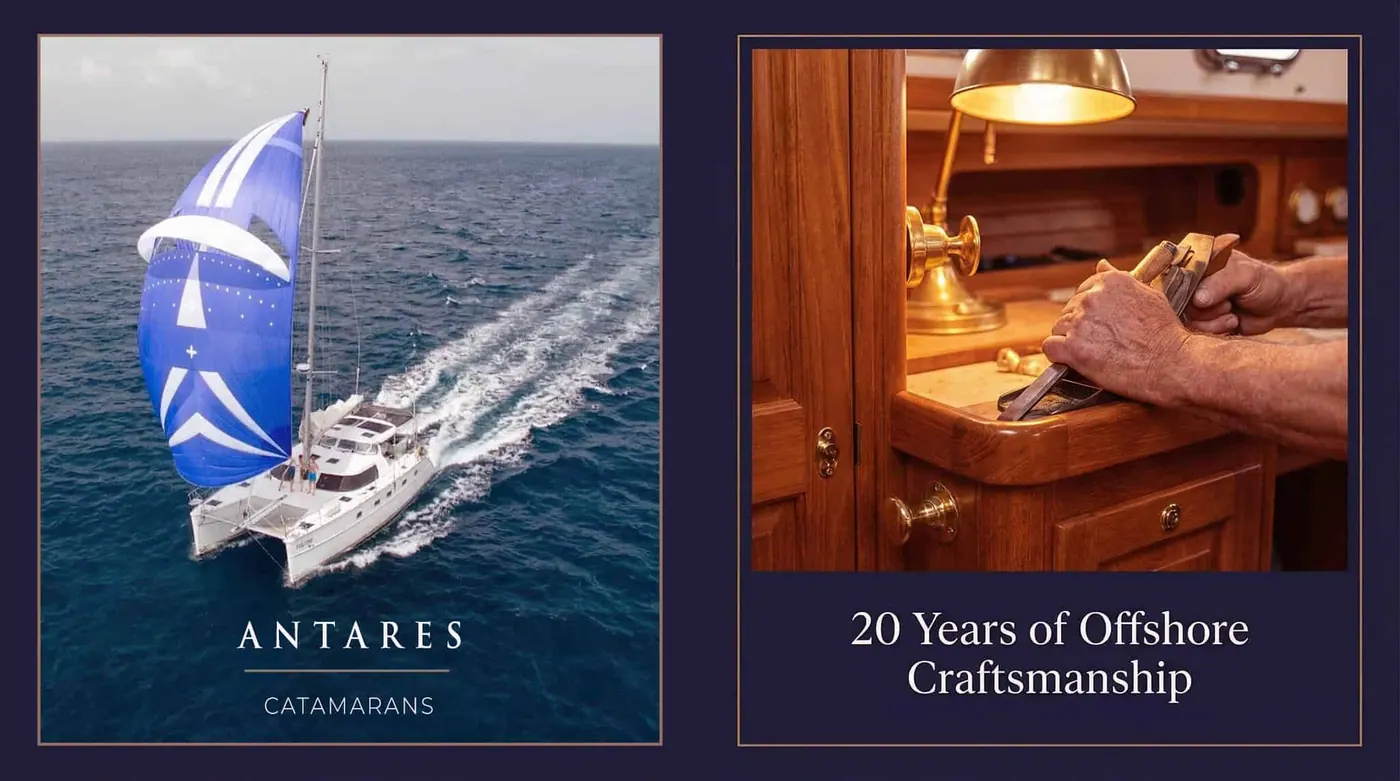
The same hands on every boat. For over 14 years, the same team has built every interior. They know every joint, every piece of wood, every particular challenge that arises when fitting cabinetry into a curved hull. When they fit your cabinet door, it’s not their first — it’s their hundredth. And presumably, each one got a little better. Here are some sample photos of the handmade, luxurious interiors of the Antares.
Production builders rotate crews. You get standardization, but you lose something else. Knowledge lives in muscle memory, not manuals. There is no “I think the last guy did it this way.” Only “I did this exact thing on the last boat, and here’s what I learned.” When you’re building 40 boats per year with rotating crews, knowledge lives in documentation. When you’re building 3-4 with the same craftsmen, knowledge lives in their hands.
Time to get it right. In production boat building, if something isn’t quite right — a door doesn’t fit perfectly, a laminate isn’t quite flush — you make a judgment call. Is it good enough? Will the customer notice? You move on, because the schedule matters. At 3-4 boats per year, if something isn’t right, you redo it. There’s no Hull #248 waiting impatiently in line. The only relevant standard: is this good enough to cross an ocean?
Every boat is your reputation. When you build 3-4 boats per year, every boat represents 25-33% of your annual work. You can’t hide problems in volume. Compare that to a builder producing 100+ boats — each one is roughly 1% of production. Problems get written off as statistical noise. At this scale, every boat is “the next one.”
Semi-custom becomes possible. When you’re building 40 boats a year, customization is something of a nightmare. When you’re building 3-4, it’s simply how things work. Want a different galley counter height? That can be arranged. Custom cabinet configuration? We can draw that up. The hull and core systems stay consistent — one doesn’t experiment with fundamental architecture — but within that framework, there’s room for your boat to actually be yours.
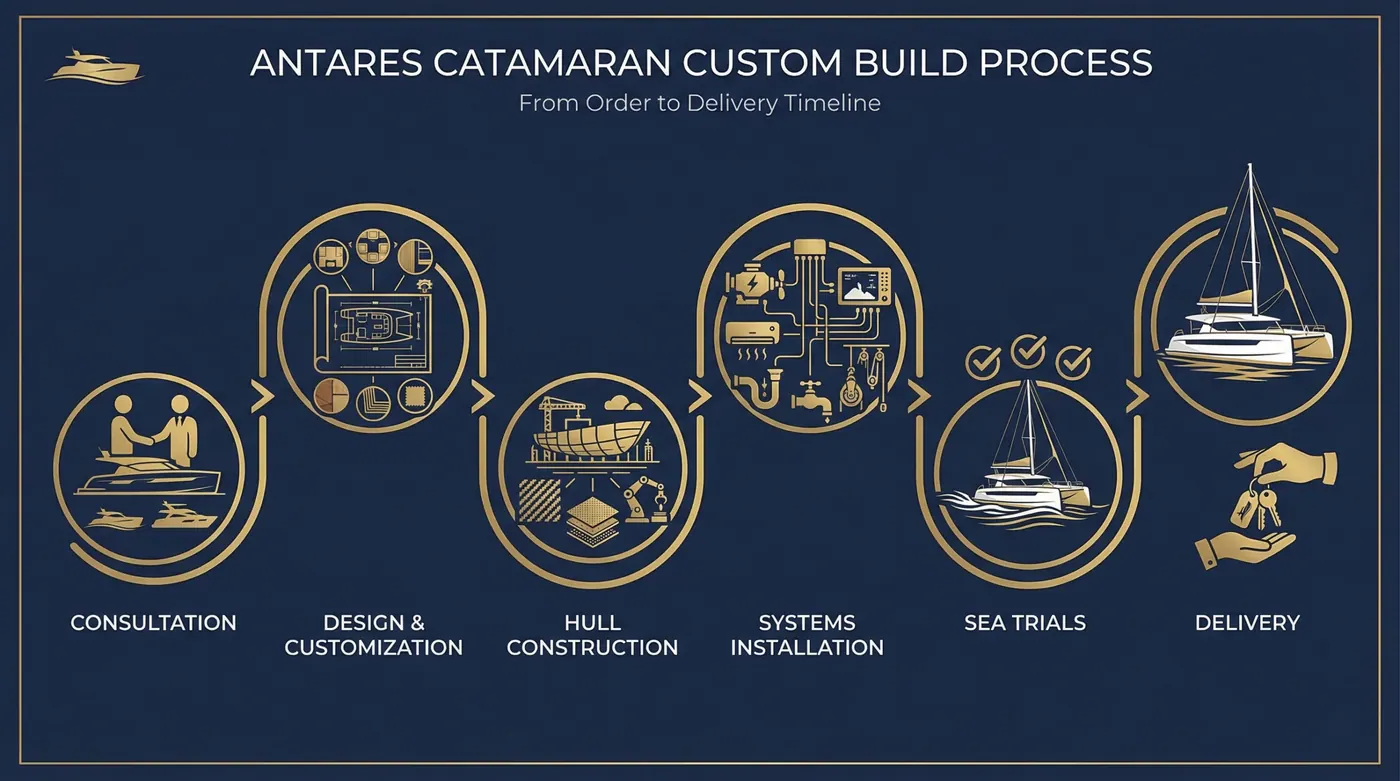
What About Delivery Times?
Here’s the honest answer: if you order a new boat today, you’re joining a queue. Depending on current orders, it might be 18+ months.
But here’s what you’re getting for that wait: a boat built without corners cut, by craftsmen who aren’t rushing to the next hull, with every system installed correctly because there’s time to do it right.
Suppose we consider the alternative. A production boat delivered in 4 months with “minor issues” you’ll spend the next year addressing while trying to cruise. Fast delivery isn’t particularly valuable if the boat requires subsequent correction.
Most long-distance cruisers spend 1-2 years preparing anyway — learning systems, getting certifications, planning routes. A 12-24 month build aligns reasonably well with that timeline. You’re not waiting for a boat. You’re waiting for your boat.
What Owners Say
Multiple boats of this design have completed circumnavigations — 40,000+ miles in some cases, or so I’m told. When you talk to owners, you hear certain recurring themes:
- “The build quality is exceptional” (as they sit next to other catamarans in the anchorage)
- “I know the people who built my boat” (an increasingly rare phenomenon)
- “Nothing rattles, nothing leaks, nothing fails” (a bold claim, but I suppose one expects such confidence from owners)
- “It’s built like furniture, not a production boat” (an observation about joinery standards, compared to IKEA outfitted boats)
That’s what 3-4 boats per year sounds like after thousands of miles offshore.
The Bottom Line
They could build more boats per year. They could hire additional workers, expand the facility, and pursue volume. They won’t.
Because the goal isn’t to build the most boats. The goal is to build boats that don’t disappoint.
Maybe the Patek Philippe analogy is apt, or maybe it’s pretentious. But there’s something to the notion that when you’re creating something intended to outlast its owner, you can’t approach it as a production exercise.
If you’re inclined to investigate further, current build slots and timelines are available. No one is going to speed up production to accommodate demand. But if you’re willing to wait for something built properly, well — they’re willing to build it. To learn more about the Antares 44 or Antares 46, click on the links.
3-4 boats per year. Every year. For over 20 years. That’s not a limitation. That’s simply the pace at which this sort of work can be done properly.
Isn’t that the only philosophy we can all live with?