
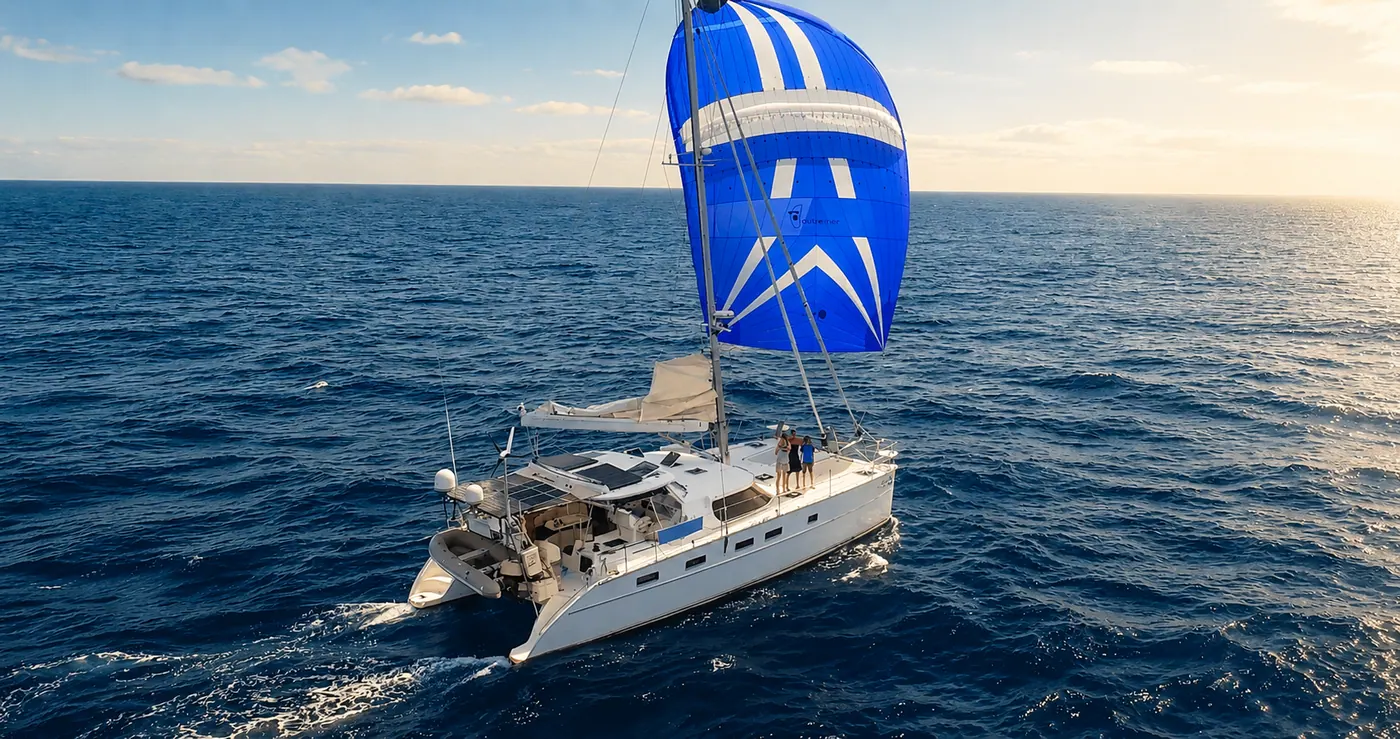
Can a cruising catamaran handle rough seas?
A well-designed, maintained, and competently operated cruising catamaran can handle rough offshore conditions, but no boat makes rough seas safe by itself. Safety depends on the specific boat, loading, maintenance, sail plan, sea room, crew condition, and decisions made before conditions peak. The practical goal is to reduce loads early, protect the crew, preserve steering and propulsion options, and keep enough margin to change course or tactics.
- Catamarans can handle rough seas when boat condition, loading, sail plan, crew readiness, and tactics stay within the design and weather margin.
- Reduce sail and speed before conditions peak, keep watchkeepers protected, and confirm steering and propulsion access before departure.
- Avoid schedules that pressure the crew to continue when changing course, slowing down, or waiting is the safer option.
The Captain’s Summary: Any boat can handle fair winds, but the true test of a blue water catamaran is how she behaves when the barometer drops and the seas build. We analyze real-world performance data to show why hull design, bridge deck clearance, and systems redundancy are the critical factors for safe offshore passage making.
Key Takeaways
- Stability in Following Seas: Skeg-hung rudders and hull buoyancy prevent “bow burying” even at speeds approaching 20 knots.
- The Comfort Factor: Superior bridge deck clearance eliminates the jarring “slap” found on charter-style catamarans.
- Systems Independence: logically routed systems allow owners to perform repairs at sea without specialized mechanic skills.
- Redundancy is Standard: From autopilots to filtration, backup systems are essential for the “safety first” mindset.
Handling Heavy Weather: The Antares Hull Advantage
The fear of capsizing or “pitchpoling” is a primary concern for sailors transitioning to multihulls. However, naval architecture dictates safety more than size. In real-world conditions, facing squalls with wind speeds exceeding 40 to 60 knots, the Antares hull shape demonstrates exceptional buoyancy.
Unlike performance cats with razor-thin bows that risk burying into the wave ahead, the Antares buoyancy distribution keeps the bows up. Owners have recorded surfing speeds of 19.8 knots down large following seas with the autopilot engaged. In these conditions, the vessel remains stable, lifting over the waves rather than driving through them. This “cork-like” buoyancy ensures that even in rough sea states—described by captains on board as a “rollercoaster”—the vessel remains secure, tracking straight without the dangerous tendency to broach.
Tracking and Control: Skeg-Hung Rudders
A critical safety feature often overlooked in marketing brochures is the rudder design. Many production catamarans utilize spade rudders, which are vulnerable to debris and offer less directional stability. The Antares Advantage lies in our skeg-hung rudders.
When surfing down large waves in the Atlantic or Pacific, these keels act like rails, keeping the boat tracking dead straight. This reduces the load on the autopilot and the helmsman. While other vessels may require a drogue to maintain control in 50-knot winds, the Antares design allows for continued safe passage making, sliding down the face of waves with controlled acceleration rather than chaotic yawing.
Bridge Deck Clearance: Comfort is a Safety Feature
One of the most fatiguing aspects of offshore sailing is “bridge deck slap”—the sound and impact of waves hitting the underside of the salon floor. To maximize interior volume, many competitors lower the bridge deck, resulting in a jarring ride that shakes the rigging and exhausts the crew.
We prioritize sea-kindliness. The Antares features a narrower beam relative to its length and significant bridge deck clearance. This design allows waves to pass between the hulls without impacting the structure. Even on a 3,000 nautical mile run, such as the “Coconut Run” from the Galapagos to the Marquesas, this clearance ensures the crew arrives rested, rather than battered by constant impact.
Blue Water Independence: Repairs and Redundancy
True independence means being able to fix your boat 1,000 miles from the nearest chandlery. A luxury interior is useless if the systems behind it are inaccessible. We design our mechanical spaces with the owner in mind.
Whether it is swapping a freshwater pump or changing a fuel filter, access is immediate. There is no need to dismantle cabinetry to reach critical components. The wiring and plumbing are arranged logically, like a well-organized circuit board. This helps owners with limited mechanical background find problems and change parts.
The Philosophy of Redundancy
For long-range cruising, redundancy is not optional; it is mandatory.
- Autopilots: On a shorthanded passage, the autopilot is your third crew member. We recommend and facilitate the installation of dual independent autopilot drives.
- Filtration: Multiple barriers of fuel and water filtration ensure that bad bunkers in remote ports don’t stop your engines.
- Safety Margins: We choose equipment that is stronger than the standard loads. This gives us a safety margin when conditions get worse.
Passage Planning & Watch Schedules
Technology has changed the face of night sailing. With modern AIS (Automatic Identification System) and properly tuned Radar, squalls and traffic are visible long before they are felt. This visibility allows for “Schnoz Ball” navigation—identifying the pressure gradient of a squall on radar and maneuvering to the edge of the system to minimize impact.
Reliable systems allow for flexible watch schedules. Whether utilizing a traditional 3-hour on/off rotation or a biological clock-based schedule (Night Owls vs. Early Risers), the comfort of the enclosed, glass-windshield helm station ensures that the watchkeeper is protected from the elements, dry, and alert.
Performance Specifications: Ocean Data
| Metric | Observed Antares Performance |
|---|---|
| Max Surf Speed (Autopilot) | 19.8 Knots (No bow burying) |
| Heavy Weather Handling | Stable in sustained 40-50 knots; surviving gusts up to 76 knots |
| Bridge Deck Clearance | High clearance design minimizes wave impact/slap |
| Rudder Configuration | Skeg-hung for impact protection and tracking |
Conclusion
The ocean is unpredictable, but your vessel shouldn’t be. The Antares is designed not just for the destination, but for the safety and comfort of the journey in between. When you are ready to talk about what makes this the best liveaboard catamaran, we are here to help.