
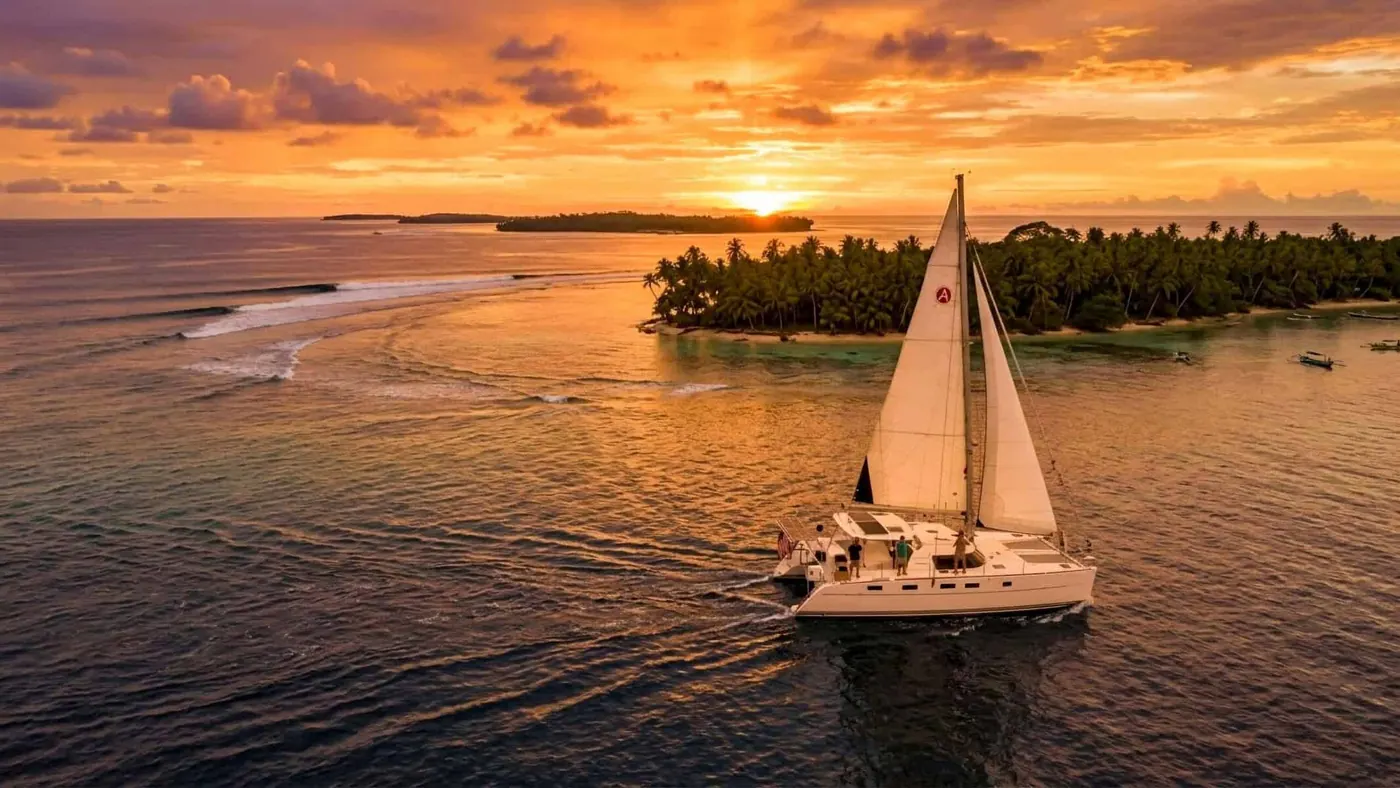
The right hull choice depends on how you plan to live, sail, maintain, and cruise.
- The original comparison guide is preserved below with its sections, tables, links, graphics, and buyer logic.
- A catamaran-versus-monohull decision should be tied to stability, space, motion, maintenance, docking, offshore plans, and total ownership cost.
- For Antares buyers, the useful next step is matching the platform decision to crew comfort, systems access, passage plans, and support expectations.
It’s the question every offshore-minded sailor eventually faces. You’ve done your coastal cruising, taken the ASA courses, and maybe chartered a few times. Now you’re ready for something bigger — a boat capable of ocean passages, perhaps even a circumnavigation. And that’s when the debate begins: catamaran or monohull?
After 30,000+ nautical miles and years of living aboard, I can tell you this isn’t just about specs on a spreadsheet. It’s about how you want to live on the water. The right choice depends on your priorities, your crew, and how you envision your time at sea.
This guide cuts through the tribalism you’ll find in sailing forums. Both hull types have merits. Both have compromises. Let’s examine them honestly.
Stability & Comfort: The Game Changer
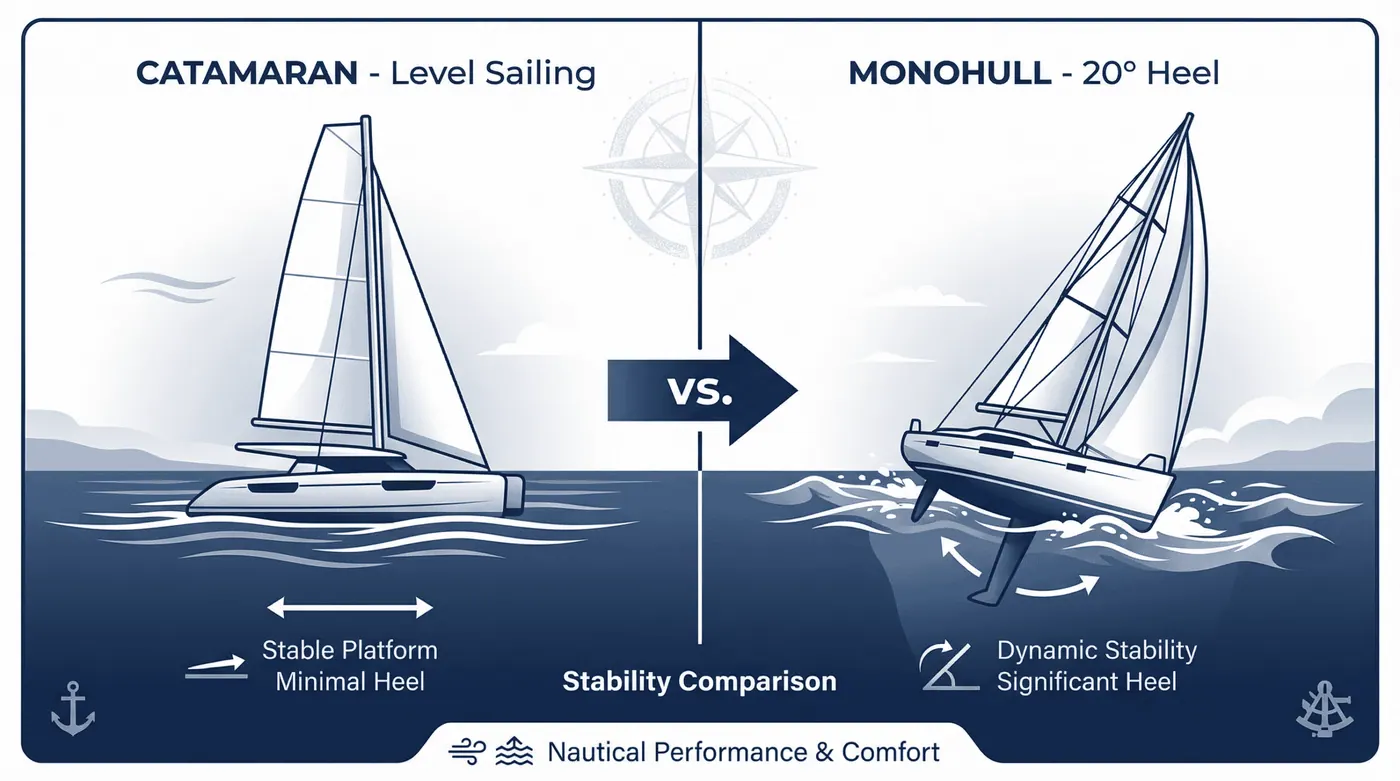
If there’s one area where catamarans fundamentally redefine sailing, it’s stability.
No Heeling. Ever.
Here’s what monohull sailors don’t fully grasp until they experience it: a catamaran doesn’t heel. When the wind pipes up, you don’t find yourself bracing in the cockpit, tacking from one side to the other, or wedging yourself into a corner berth at 20 degrees of heel. The boat stays flat. Your coffee stays in your cup. Your sleep isn’t interrupted (as much) by the rhythmic leaning that monohull cruising requires.
This isn’t a minor convenience — it’s transformative. It means:
- Cooking is genuinely pleasant, even in rough conditions
- Moving about the boat doesn’t require acrobatics
- Your guests (especially non-sailors) don’t get seasick less often from the constant motion
- You can read, work, or navigate most of the time comfortably (rough weather is rough weather on any boat)
For anyone planning extended passages or living aboard full-time, this stability becomes essential, not optional. Fatigue accumulates differently when your world isn’t constantly tilting.
Motion Comfort Underway
Catamarans have a different motion than monohulls — there’s more of a “hobby horse” effect in certain sea states, and some cats can be prone to pitching in steep waves. But modern bluewater catamarans like the Antares 44 and Antares 46 are engineered specifically for offshore conditions, with hull designs that minimize the motion characteristics that trouble lesser designs.
In beam seas, cats can have a sharper motion than displacement monohulls. This is my wife’s least favorite point of sail. But overall, for the average cruiser doing trade-wind routes, the stability advantage outweighs this. Most cruising routes follow predictable wind patterns where beam-sea exposure is temporary.
Space & Layout: Living Aboard Made Real
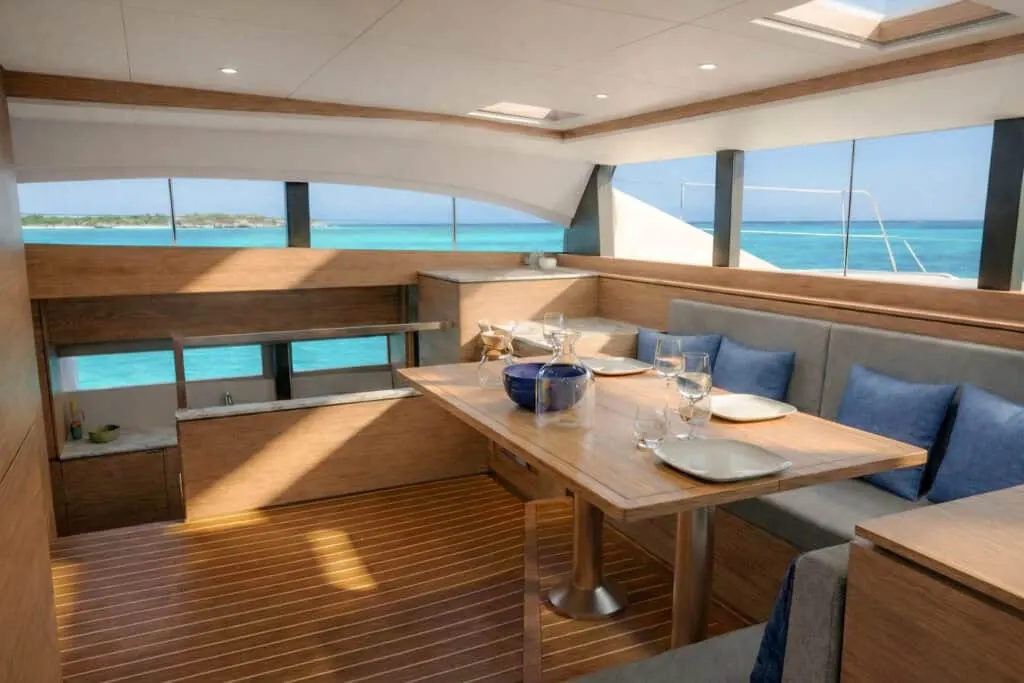
This is where the architectural difference becomes most apparent. A 44-foot catamaran and a 44-foot monohull are not comparable living spaces. Not even close.
The Bridge Deck Advantage
Catamarans place the main living area on a bridge deck spanning the two hulls. The result is a panoramic salon with 360-degree visibility, standing headroom throughout, and a layout that feels more like a waterfront apartment than a boat cabin.
In practical terms, a 44-foot cat typically offers:
- Equivalent living space to a 55-60 foot monohull
- A master cabin comparable to a small hotel room
- True guest cabins with standing headroom (not converted sail lockers)
- Full-sized galley with proper counter space and storage
- Separate nav station rather than a corner of the salon
Dual Hull Privacy
The hull configuration naturally creates privacy zones. When guests are aboard, they have their own hull with cabins, heads, and separation from the owners. On a monohull, everyone’s sleeping in the same longitudinal space — forward cabin, aft cabin, salon berths — with thin bulkheads and no real privacy.
For families, this means teenagers can have their own space. For couples cruising with friends, it means maintaining relationships that outlast the voyage (been there, done that). The social dynamics of a catamaran are fundamentally more sustainable for long-term cruising.
Deck Space & Outdoor Living
The cockpit on a cruising catamaran becomes an outdoor room — shaded, protected, and connected to the salon through wide doors that effectively merge indoor and outdoor space. Add the foredeck trampolines, and you have multiple outdoor zones for different activities: morning coffee, afternoon reading, sunset cocktails.
Monohulls simply cannot offer this. Their cockpit space is limited by beam, their foredecks are working areas, not lounging zones, and the transition from inside to outside involves companionway stairs — a physical and psychological barrier.
Performance: Speed & Sailing Characteristics
Let’s address the concerns of sailing purists directly. Yes, there are differences. No, they’re not what most monohull sailors assume.
Speed & Light Air Performance
Catamarans are generally faster, especially off the wind and in light air. The wetted surface area is higher (meaning more drag in some conditions), but the lack of heeling means sails stay powered up when monohulls are already reefing. In 8-12 knots of wind — the reality of most trade-wind cruising — a well-designed cat will make 6-7 knots while a comparable monohull makes 5-6.
This speed difference compounds over ocean passages. A catamaran might complete a 2,000-mile passage in 10 days versus 12-13 for a monohull. That’s not just convenience — it’s two fewer days of provisioning consumption, weather exposure, and crew fatigue.
Windward Ability
Here’s where the critics have a point. Most cruising catamarans don’t point as high as modern monohulls. The typical cat makes acceptable VMG (velocity made good) sailing 50-55 degrees apparent, while a monohull might manage 40-45 degrees.
But here’s the reality check: how often are you beating to windward on an ocean passage? Trade wind routes — the Caribbean to Panama, Pacific crossings, Indian Ocean circumnavigation — are predominantly downwind or reaching. The windward disadvantage matters less than forum debates suggest.
Bluewater catamarans like Antares are optimized for these real-world conditions. The design brief isn’t winning club races — it’s efficient, comfortable passage-making where 90% of your miles are off the wind.
Light Air vs. Heavy Air Trade-offs
Catamarans excel in the 8-20 knot range where most cruising happens. In 25+ knots, they require earlier reefing and more attention to sail trim. The reward for this attention is continued speed; the risk of ignoring it is overpowering the rig.
Monohulls have more built-in “reefing” via heeling — the boat self-limits to some degree. This is forgiving for novice cruisers but frustrating for those who want to keep sailing when the breeze picks up. A properly reefed catamaran handles heavy weather confidently, as detailed in our heavy weather performance guide.
Safety: Separating Myth from Reality
The safety debate between catamaran and monohull advocates generates more heat than light. Let’s look at what actually matters.
Buoyancy & Unsinkability
Here, catamarans have a clear advantage. With positive foam flotation in each hull and watertight bulkhead compartments, a well-built catamaran is essentially unsinkable. Even holed, it remains a stable platform for rescue or repair.
Monohulls rely on watertight bulkheads and crash boxes to manage flooding, but any significant hull breach will eventually lead to sinking. The keel is particularly vulnerable — a grounding that damages the hull-keel joint can be catastrophic.
The Capsize Myth
“Catamarans capsize and don’t come back up.” You’ve heard this. It’s technically true — a cat that goes turtle stays turtle. But here’s the context that rarely accompanies the claim:
- Modern cruising cats have stability curves that make capsize extremely unlikely in normal conditions
- The threshold for capsize is typically well above conditions where any prudent sailor would be sailing anyway
- The most common capsize scenario (breaking waves in storm conditions) is equally dangerous for monohulls, which can roll and sink
- Documented cruising catamaran capsizes are vanishingly rare compared to the fleet size
As detailed in our bluewater passage planning guide, avoiding dangerous weather through good forecasting and routing is the real safety strategy — not choosing a hull type based on extreme scenarios.
Man Overboard & Recovery
Catamarans have a significant safety advantage here. The stable platform makes spotting and recovering a crew member far easier than on a heeling monohull. The swim platform between hulls provides easy water access. The visibility from the bridge deck allows you to keep visual contact with someone in the water.
On a monohull, a MOB situation in rough conditions is complicated by heeling, limited visibility from the low cockpit, and the difficulty of getting someone back aboard over a high toe rail.
Structural Integrity
Not all catamarans are created equal. Production cats built to price points can have structural issues — the bridge deck pounding in heavy seas, weakly bonded hull-to-deck joints, inadequate beam attachments. This is why bluewater experience matters in design.
Antares catamarans are built specifically for offshore use — vacuum-bagged construction, solid fiberglass below the waterline, engineered bridge deck clearance, and proven ocean-crossing track records. The safety margin isn’t about hull count; it’s about build quality.
Cost of Ownership: The Real Numbers
Let’s talk honestly about costs. Catamarans are more expensive to buy and own. Pretending otherwise serves no one.
Purchase Price
A new 44-foot bluewater catamaran costs roughly 50-70% more than a comparable monohull. The reasons are obvious: two hulls, more deck structure, more interior volume, more systems. Used catamarans hold their value well — too well, some buyers complain — because demand consistently exceeds supply.
However, the comparison needs context. A 44-foot cat offers living space equivalent to a 55-60 foot monohull. When adjusted for usable volume, the gap narrows. And for liveaboards, the question becomes: what’s the cost of a boat you’ll actually enjoy living on versus one you’ll outgrow in two years?
Marina & Dockage Fees
This is the ongoing cost that surprises many catamaran buyers. Marinas typically charge 1.5-2x for a catamaran berth compared to a monohull of the same length. Some older marinas can’t accommodate cats at all.
For full-time cruisers, this matters less than you’d think. The cruising lifestyle involves far more anchoring than marina stays — and catamarans excel at anchoring. The shallow draft (typically 3-4 feet vs. 6-7 for monohulls) opens up protected anchorages monohulls can’t access. When you do take a marina slip for provisioning or weather, the premium is real, but it’s occasional, not constant.
For those keeping a boat in a home marina and doing seasonal cruising, the dockage differential is a significant budget line item to factor in.
Maintenance & Systems
Two hulls means two engines (a redundancy advantage, not purely a cost), two sets of through-hulls, and more exterior surface area for bottom paint. However, the systems are often simpler — no complex keel bolts, no rudder posts penetrating the hull, generally less complicated rigging.
Overall, maintenance costs run 20-30% higher for catamarans. Whether this is justified depends on your use case. For a boat used 40 days a year, it might not be. For a liveaboard home completing ocean passages, the cost difference fades against the lifestyle benefits.
The Social Factor: Life Aboard with Others
This section rarely appears in comparison articles, but it might be the most important factor of all.
Entertaining & Guest Management
Catamarans are simply better for having people aboard. The cockpit/salon integration creates natural gathering spaces. Guests can be on deck, in the salon, or in their hull cabin without tripping over each other. The galley faces the living area, so the cook participates in socializing rather than being isolated below.
Monohulls work for couples. They become challenging with guests for more than a few days. The lack of privacy, the single gathering space, the gymnastic requirements of moving about — it wears on relationships.
Family Cruising
For families with children, the difference is profound. Kids need space — not just sleeping space, but hangout space, inside and outside. They need to get away from parents. They need to feel safe moving about. A catamaran provides all of this. The stability means children aren’t falling constantly or getting seasick. The separation between hulls means the whole family isn’t on top of each other 24/7.
Many families start cruising on monohulls and transition to cats when they realize the space and stability dynamics matter more than sailing purity.
The Liveaboard Lifestyle
If you’re planning to live aboard full-time, the comparison isn’t even close. The space, stability, and comfort of a catamaran make it a home; a monohull remains a boat you live on. After six months, after a year, after crossing an ocean — that distinction becomes everything.
Which Is Right For You? A Decision Framework
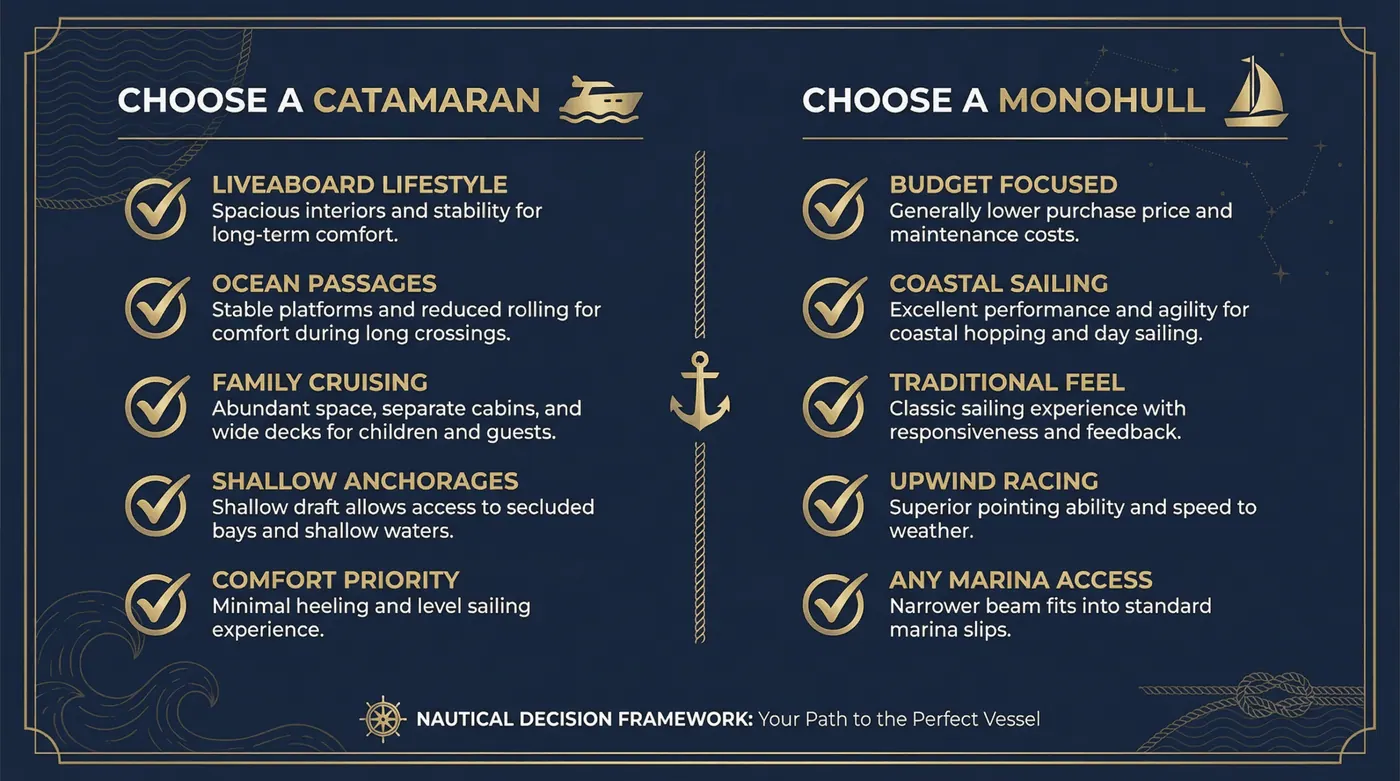
Enough comparison. Here’s how to actually decide.
Choose a Catamaran If:
- You plan to live aboard or spend extended time cruising (3+ months/year)
- You’ll regularly have guests, family, or crew aboard
- Comfort and space are priorities, not compromises
- You want to anchor in shallow, protected waters
- You’re doing predominantly downwind/ocean passages
- You’re willing to pay 30-50% more for the above benefits
Choose a Monohull If:
- Budget constraints are primary
- You primarily day sail or do short coastal hops
- You’re committed to traditional sailing aesthetics and “feel”
- You enjoy the heeling, the bracing, the “boat-ness” of sailing
- You need access to any marina (some exclude cats)
- You prioritize upwind performance over comfort
Your Owner Fit Assessment
Be honest about your actual use case, not your aspirational one. Most sailors who dream of circumnavigating end up coastal cruising and island-hopping. Most who say they’ll live aboard seasonally find reasons to stay home. There’s no shame in this — but buy for reality, not fantasy.
If you’re genuinely committed to bluewater cruising, ocean passages, and extended time aboard, the catamaran advantages compound. If you’re weekend sailing with occasional coastal trips, a monohull’s lower costs and simpler systems may serve you better.
Finding Your Bluewater Catamaran
If the catamaran path aligns with your plans, the next decision is which catamaran. The market ranges from mass-production charter designs to semi-custom luxury builds to boutique bluewater specialists.
For offshore cruising, look beyond the glossy brochures. Investigate build quality, bridgedeck clearance, engineering details, and — most importantly — owner experience from ocean crossings. Visit boats. Talk to owners. Sail before you buy.
Antares Catamarans represents the boutique bluewater approach — a small builder focused exclusively on offshore-capable cats, hand-built with vacuum-infused construction, and refined over decades of owner feedback from circumnavigations. The Antares 44 and Antares 46 are designed by sailors who have done the miles, not by committees optimizing for charter fleet sales.
For more guidance on selecting a bluewater-capable catamaran, explore our expert advice collection — real insights from real offshore experience.
The catamaran vs monohull debate will continue in sailing clubs and online forums forever. But for your decision, it comes down to this: What kind of life do you want to live on the water? Answer that honestly, and the right boat becomes clear.